
Part 2 - 3D Cartesian Vectors
Loading the math board and drawing, please wait…
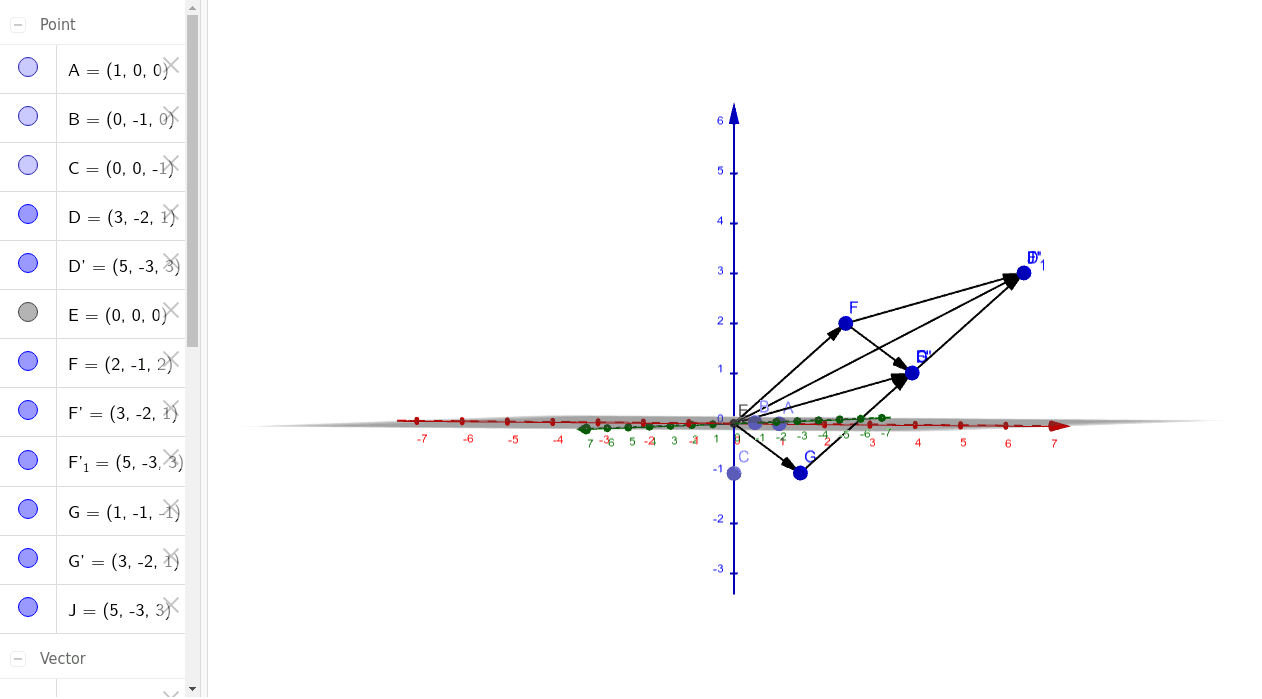
① This example demonstrates the representation and manipulation of Cartesian vectors in three-dimensional space, using geometric constructions to visualize vector translation, intersection, and combination. ② Core mathematical concepts include 3D vectors, vector addition, vector translation, the relationship between points and vectors, and the construction of triangles and polygons in space. ③ Construction details: GeoGebra commands such as Intersect, Vector, Point, and Translate are used to define multiple points (D, E, A, B, C, G), vectors (u, v, w), and derived objects (F', D', G') that illustrate vector operations and spatial relationships. ④ Suitable for high school or early college students learning 3D analytic geometry and vector algebra, as well as for teachers demonstrating dynamic vector concepts in the classroom.
GeoGebra Commands & Parameters
Intersect(zAxis, xOyPlane) → EVector(E, D) → uVector(E, F) → vPoint(xAxis) → APoint(yAxis) → BPoint(zAxis) → CVector(E, G) → wTranslate(F, w) → F'Vector(F, F') → aVector(E, J) → bTranslate(F, u) → F'_1Vector(F, F'_1) → cTranslate(D, v) → D'Vector(D, D') → dTranslate(G, v) → G'Vector(G, G') → e
AI Drawing Prompt Reference
Visualize the representation and manipulation of Cartesian vectors in 3D space, showing vector translation, intersection, and combination through geometric constructions, including the relationship between points and vectors, and the formation of triangles and polygons in space.
The prompt above was compiled from the original drawing commands and is for reference only.