
Parallelogram Characteristics Demo
Loading the math board and drawing, please wait…
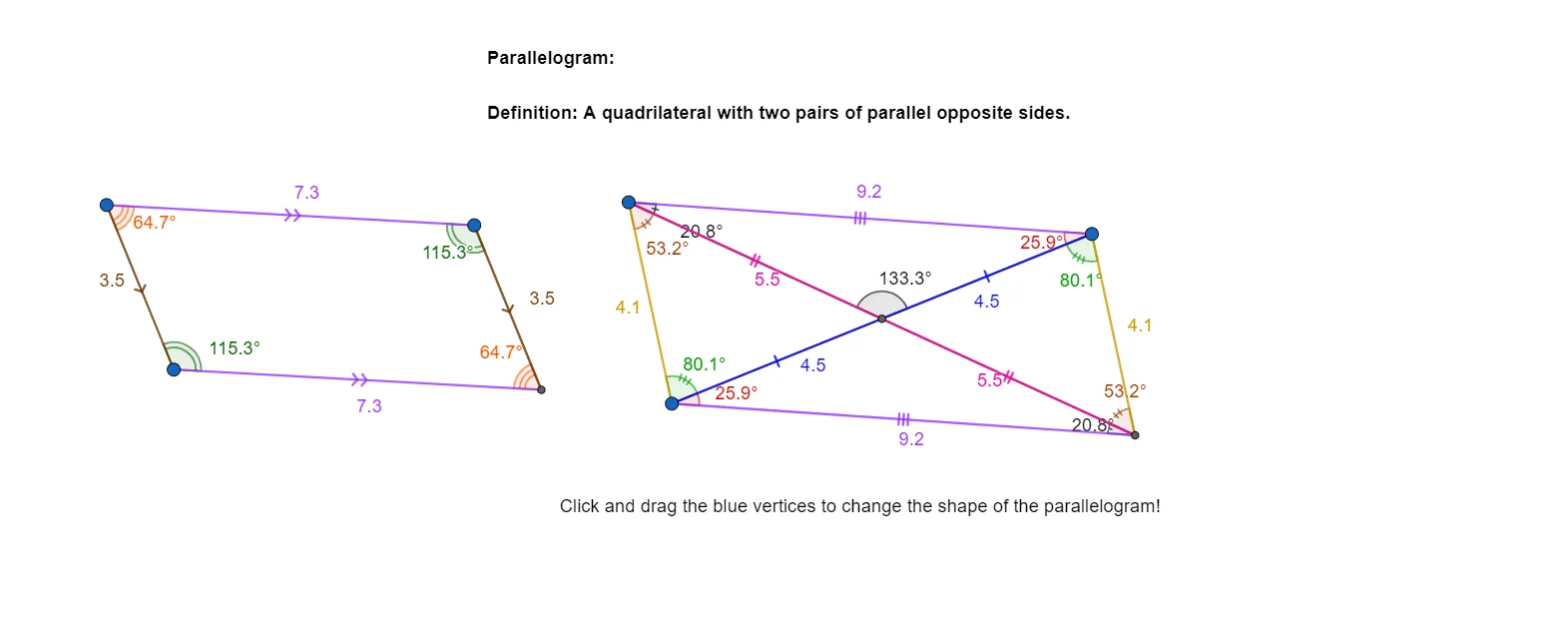
This example demonstrates the geometric properties of a parallelogram, including parallel opposite sides, equal opposite sides, equal opposite angles, and supplementary adjacent angles. Core math concepts involved are parallel lines, vectors, angles, geometric transformations, and congruence. Construction highlights use of GeoGebra commands like Segment, Line, Intersect, and Angle to build and verify parallelogram properties. Suitable for middle school and above students learning parallelogram characteristics and geometric transformations.
GeoGebra Commands & Parameters
Segment(A, B) → fLine(C, f) → gSegment(A, C) → hLine(B, h) → iIntersect(g, i) → DAngle(D, C, A) → αAngle(C, A, B) → βAngle(A, B, D) → γAngle(B, D, C) → δSegment(E, F) → lLine(G, l) → mSegment(E, G) → nLine(F, n) → pIntersect(m, p) → HSegment(G, H) → qSegment(H, F) → rSegment(E, H) → sSegment(G, F) → tIntersect(s, t) → IAngle(F, I, E) → εAngle(I, E, F) → ζAngle(G, F, E) → ηAngle(E, G, F) → θAngle(F, G, H) → ιAngle(F, H, E) → κAngle(E, H, G) → λAngle(G, E, H) → μAngle(G, F, H) → νSegment(G, I) → aSegment(I, E) → bSegment(I, F) → cSegment(I, H) → dSegment(B, D) → eSegment(C, D) → j