
Parallel Lines, Skew Lines, and Parallel Planes by Michael Bailey
Loading the math board and drawing, please wait…
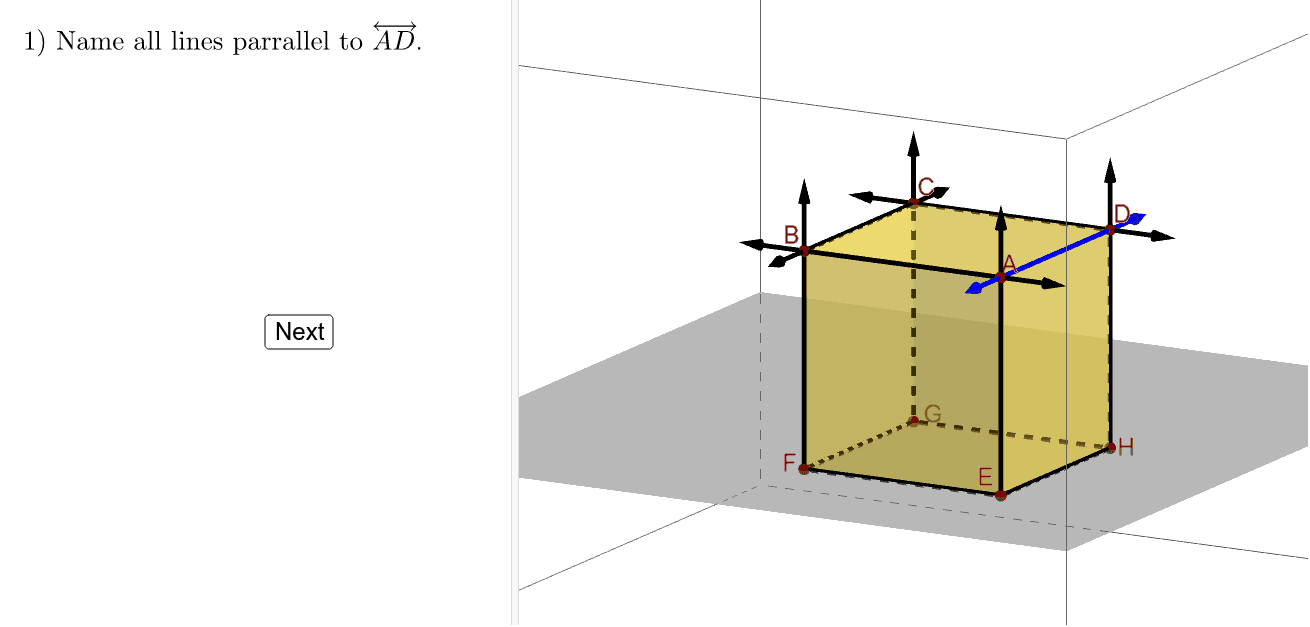
This example demonstrates the relationships and properties of parallel lines, skew lines, and parallel planes in three-dimensional space. Key math concepts include spatial geometry, line-plane relationships, and vector operations. It is constructed using commands like Intersect, Point, Prism, and Vector, creating points, lines, planes, and vectors. Suitable for high school solid geometry teaching and learning, helping to understand spatial line-plane positional relationships.
GeoGebra Commands & Parameters
Intersect(yAxis, xAxis) → GPoint(yAxis) → FPoint(xAxis) → HPoint(zAxis) → CPrism(G, F, E, H, C) → a, B, edgeAB, edgeBC, edgeCD, edgeAD, edgeAH, edgeBE, edgeCF, edgeDG, edgeEH, edgeEF, A, edgeFG, edgeGH, D, faceABCD, faceABEH, faceBCFE, faceCDGF, faceADGH, faceEFGHVector(C, (0, 0, 4)) → vVector(C, (-1, 0, 3)) → wVector(C, (0, 1, 3)) → uVector(B, (0, -4, 3)) → bVector(B, (-1, -3, 3)) → cVector(B, (0, -3, 4)) → dVector(A, (3, -4, 3)) → eVector(A, (3, -3, 4)) → fVector(A, (4, -3, 3)) → gVector(D, (4, 0, 3)) → hVector(D, (3, 1, 3)) → iVector(D, (3, 0, 4)) → j
AI Drawing Prompt Reference
Draw parallel lines, skew lines, and parallel planes in 3D space to demonstrate their relationships and properties. Start by identifying the intersection points of coordinate axes and the origin, then create parallel planes using a prism operation. Define multiple vectors to represent different directions and use them to draw parallel and skew lines. Finally, combine all elements to clearly present the characteristics of spatial line-plane positional relationships.
The prompt above was compiled from the original drawing commands and is for reference only.