
Parallel Lines Congruent Segments Theorem Demo
Loading the math board and drawing, please wait…
In collections
Congruence (CO) Cluster
Congruence (Vol 2)
CCSS High School: Geometry (Congruence) Volume 2
CCSS High School: Geometry (Congruence) Volume 2
CCSS High School: Geometry (Congruence) Volume 2
Geometry (Congruence) Volume 2
CCSS High School: Geometry (Congruence) Volume 2
CCSS High School: Geometry (Congruence) Volume 2
CCSS High School: Geometry (Congruence) Volume 2
CCSS High School: Geometry (Congruence) Volume 2
CCSS High School: Geometry (Congruence) Volume 2
CCSS High School: Geometry (Congruence) Volume 2
CCSS High School: Geometry (Congruence) Volume 2
Gail LeBlancCCSS High School: Geometry (Congruence) Volume 2
CCSS High School: Geometry (Congruence) Volume 2
Similarity & Right Triangle Trigonometry
Similarity, Right Triangles, and Trigonometry (SRT) Cluster
Parallel Lines & Related Angles
Parallel Lines & Related Angles
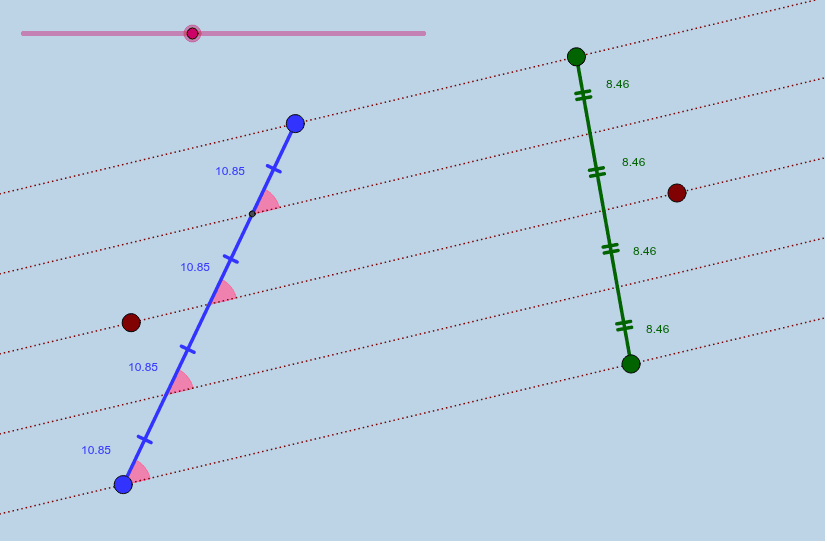
This example demonstrates the Parallel Lines Congruent Segments Theorem, showing that when parallel lines are cut by a transversal, corresponding segments are equal. It involves core concepts like parallel line properties, congruent triangles, and segment equality. Constructed using GeoGebra commands/objects such as Line, Circle, OrthogonalLine, Intersect, Distance, Point, Segment, and CircleSector. Suitable for high school geometry teaching to visually illustrate the theorem.
GeoGebra Commands & Parameters
Line(A, B) → a_1Circle(A, a) → cOrthogonalLine(A, a_1) → bIntersect(c, b, 1) → COrthogonalLine(C, b) → dIntersect(c, b) → D, EOrthogonalLine(E, b) → eCircle(E, a) → fIntersect(f, b, 2) → FOrthogonalLine(F, b) → gCircle(C, a) → hIntersect(h, b) → G, HOrthogonalLine(G, b) → iDistance(F, E) → distanceFEDistance(E, A) → distanceEADistance(A, C) → distanceACDistance(C, G) → distanceCGPoint(b) → IPoint(b) → JPoint(g) → KPoint(i) → LLine(K, L) → jIntersect(e, j) → OIntersect(a_1, j) → PIntersect(d, j) → QSegment(K, O) → kSegment(O, P) → lSegment(P, Q) → mSegment(Q, L) → nPoint(g) → MPoint(i) → NSegment(M, N) → pIntersect(e, p) → RIntersect(a_1, p) → SIntersect(d, p) → TSegment(M, R) → qSegment(R, S) → rSegment(S, T) → sSegment(T, N) → tCircle(N, 3) → c_1Circle(T, 3) → d_1Circle(S, 3) → e_1Circle(R, 3) → f_1Intersect(f_1, e, 1) → UIntersect(f_1, q, 1) → VIntersect(e_1, a_1, 2) → WIntersect(e_1, r, 1) → ZIntersect(d_1, d, 1) → A_1Intersect(d_1, s, 1) → B_1Intersect(c_1, i, 1) → C_1Intersect(c_1, t, 1) → D_1CircleSector(R, U, V) → g_1CircleSector(S, W, Z) → h_1CircleSector(T, A_1, B_1) → k_1CircleSector(N, C_1, D_1) → p_1
AI Drawing Prompt Reference
Draw two parallel lines intersected by a transversal. At one intersection point, draw a circle and a perpendicular line to the transversal that intersects the circle at a point. From this point, draw a circle that intersects the perpendicular line at two points. Connect these points to the transversal intersection to form two congruent triangles. Highlight equal segments with arcs and lines to demonstrate that corresponding segments between parallel lines cut by a transversal are congruent.
The prompt above was compiled from the original drawing commands and is for reference only.