
Parallel Lines and Transversals: Dynamic Angle Relationships
Loading the math board and drawing, please wait…
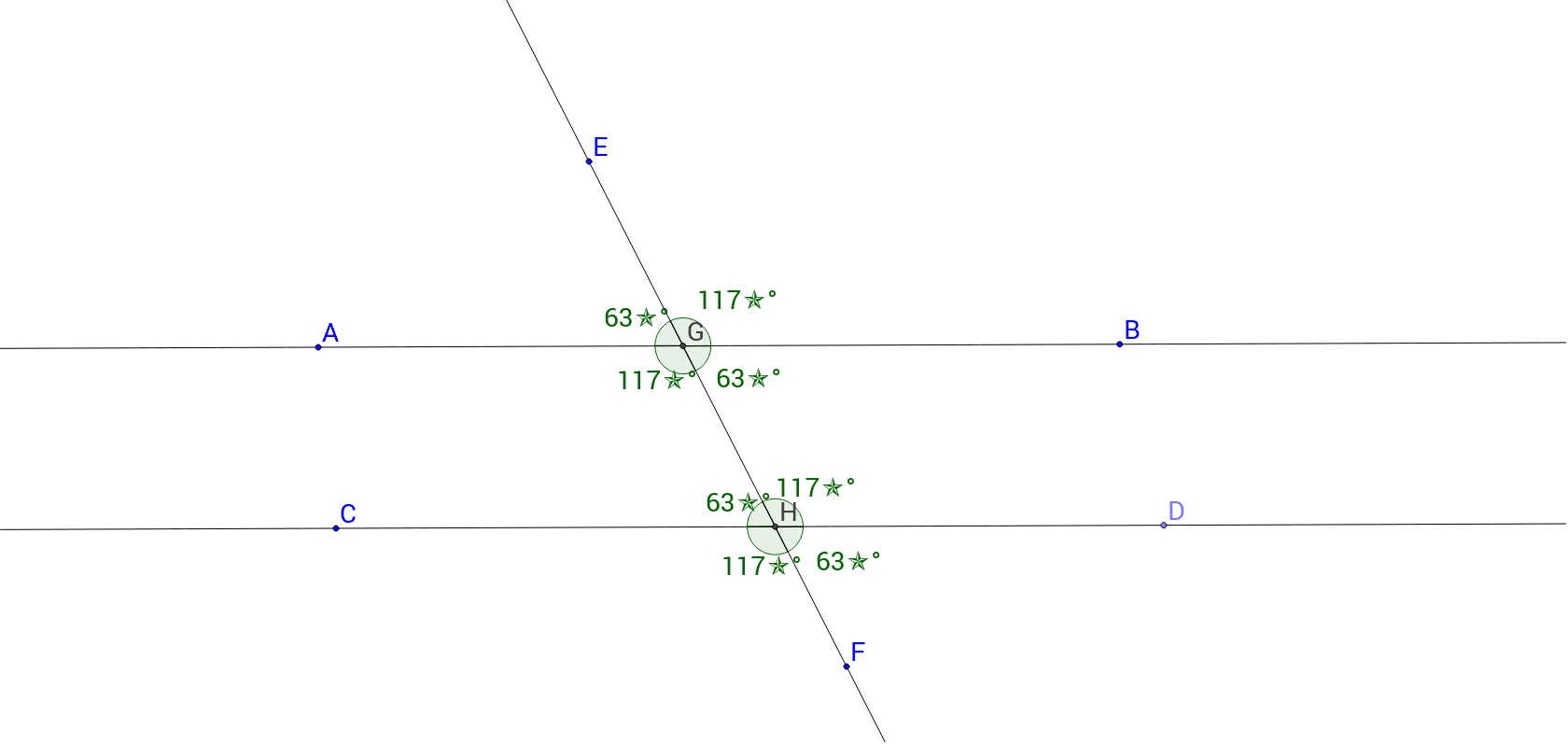
This example demonstrates two parallel lines cut by a transversal, showing how eight angle measures change when points are dragged while angle relationships remain invariant. It covers parallel lines, transversals, corresponding angles, alternate interior angles, same-side interior angles, vertical angles, and supplementary angles. The GeoGebra construction uses Line, Point, Intersect, and Angle commands to create points A, B, C, D, E, F, G, H, lines a, b, c, and angles α, β, γ, δ, ε, ζ, η, θ. It is suitable for middle-school geometry, parallel-line properties, classroom demonstrations, and student exploration.
GeoGebra Commands & Parameters
Line(A, B) → aLine(C, a) → bPoint(b) → DLine(E, F) → cIntersect(c, a) → GIntersect(b, c) → HAngle(B, G, E) → αAngle(E, G, A) → βAngle(A, G, H) → γAngle(H, G, B) → δAngle(D, H, G) → εAngle(G, H, C) → ζAngle(C, H, F) → ηAngle(F, H, D) → θ
AI Drawing Prompt Reference
Draw two parallel lines a and b, then draw a line c that intersects both, and label the eight angles formed by line c and the two parallel lines a and b as α, β, γ, δ, ε, ζ, η, θ, ensuring that the relationships between these angles remain invariant when points are moved.
The prompt above was compiled from the original drawing commands and is for reference only.