
Parabola Manipulative
Loading the math board and drawing, please wait…
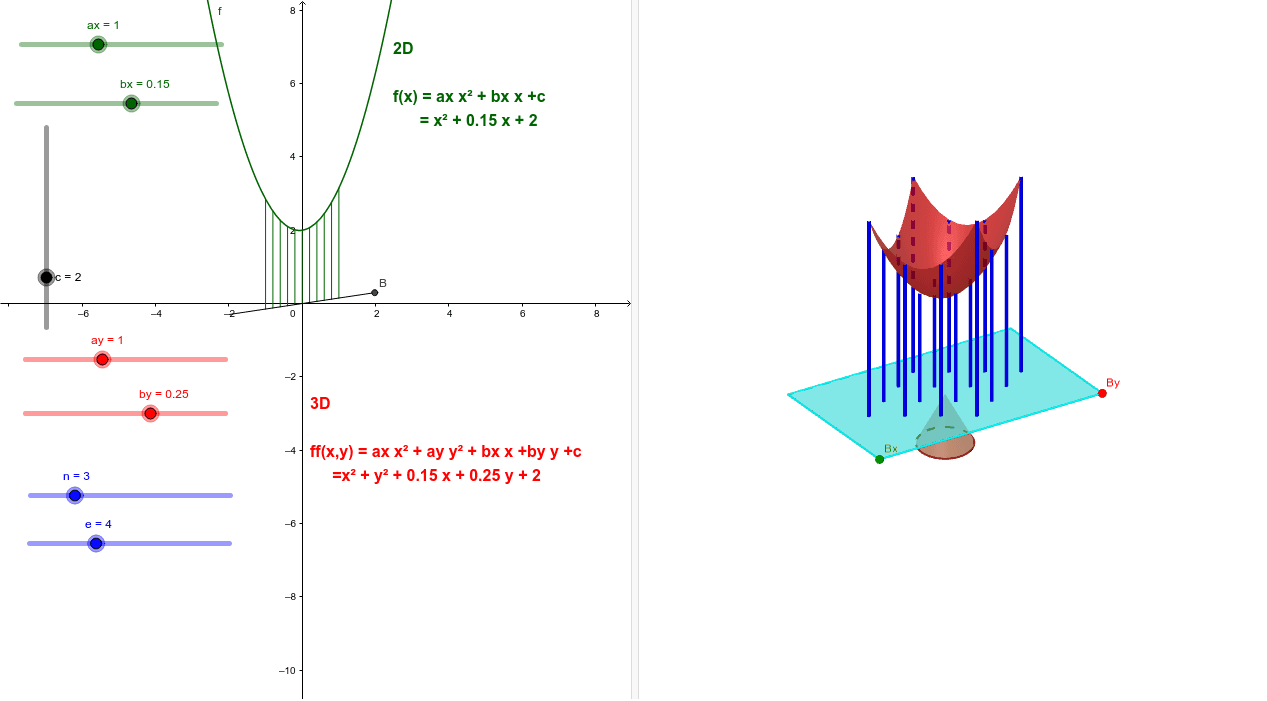
This example demonstrates the geometric properties of a parabola. Key mathematical concepts include quadratic functions, roots, and vectors. Using GeoGebra commands such as Sequence, Polygon, and Segment, you can dynamically adjust the parameters of the parabola and observe its changes. Suitable for high school mathematics education and learning.
GeoGebra Commands & Parameters
Sequence(Segment[(i, f(i) - ((ax * i^(2)) + c)), (i, f(i))], i, -1, 1, 0.2) → liste1Polygon(Bx, By, Mirror[Bx, (0, 0, 0)], Mirror[By, (0, 0, 0)]) → poly1, e_1, g, h, iSegment(B, Mirror[B, (0, 0)]) → jSequence(Sequence[Segment[(i, j, ff(i, j) - ((ax * i^(2)) + (ay * j^(2)) + c)), (i, j, ff(i, j))], i, -1, 1, 2 / n], j, -1, 1, 2 / n) → liste2Surface(u, v, ff(u, v), u, -1, 1, v, -1, 1) → kCone((0, 0, -1), (0, 0, 0), 0.5) → a, d, b
AI Drawing Prompt Reference
Draw a parabola and observe its changes by adjusting parameters. First, plot points on the parabola and their tangents, then construct a quadrilateral using these points and tangents. Next, draw the axis of symmetry of the parabola. Finally, use the sequence command to draw a series of parabolas parallel to the axis of symmetry, forming a surface, and draw a cone.
The prompt above was compiled from the original drawing commands and is for reference only.