
Slope of a Line: Horizontal and Vertical Change
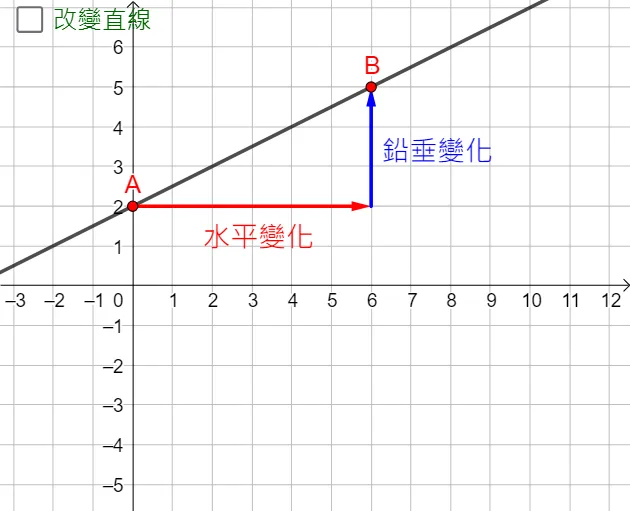
This example demonstrates how to calculate the slope of a line using the horizontal change (run) and vertical change (rise) between any two points on the line. The construction features interactive points A and B that students can drag to different positions along the line, along with colored vectors u and v that visually represent the horizontal displacement and vertical displacement between the two points. These visual tools help learners intuitively grasp the geometric meaning of the slope formula m = rise / run. As students move points A and B, the applet dynamically updates the run and rise values, showing in real time how changes in position affect the calculated slope. The step-by-step presentation and dynamic adjustment capability reinforce the connection between the algebraic slope formula and its geometric interpretation. Special cases are also explored: when the line is horizontal, the rise is zero and the slope equals zero; when the line is vertical, the run is zero and the slope is undefined. This hands-on exploration allows students to discover key properties of slope on their own. The applet is particularly valuable for helping students understand why the slope of a straight line remains constant regardless of which two points are chosen, since any pair of points will yield the same ratio of rise to run. Educators can use this applet as an interactive teaching aid during lessons on linear functions, coordinate geometry, and the foundations of calculus. Students benefit from the immediate visual feedback and the ability to experiment freely, building both conceptual understanding and computational fluency with slope calculations.
Loading the math board and drawing, please wait…