
Parabola in Vertex Form - Dynamic Exploration
Loading the math board and drawing, please wait…
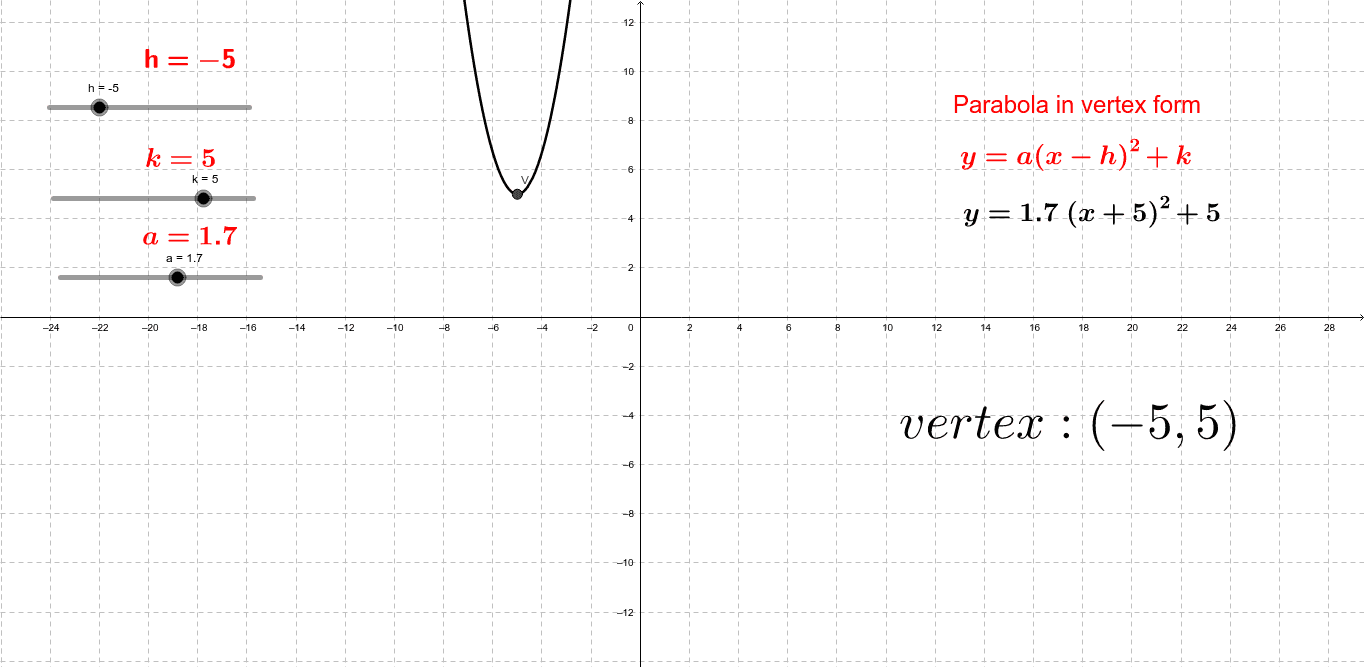
① This example demonstrates how the graph of a parabola in vertex form y = a(x-h)² + k changes as the parameters h, k, and a are adjusted via sliders. ② Core mathematical concepts include the vertex form of a quadratic function, horizontal and vertical translations, vertical stretching/compression and reflection, the vertex coordinates, and the axis of symmetry. ③ Construction highlights: GeoGebra sliders for h, k, and a are used to define the vertex point V and the function f; multiple text objects (text1 through text7) display the current parameter values, vertex coordinates, and the function equation, providing immediate visual feedback. ④ This resource is suitable for middle school to high school students learning quadratic functions, as well as for teachers demonstrating transformations in class or for students conducting self-guided exploration of how parameters affect the parabola's shape.
GeoGebra Commands & Parameters
Numeric h(-5.0)Numeric k(5.0)Numeric a(1.7)(h, k)f(x) = (a * (x - h)^(2)) + k
AI Drawing Prompt Reference
Draw a coordinate plane with a parabola in vertex form, where the vertex is determined by two adjustable parameters and a third parameter controls the opening direction and width. Include three sliders to adjust the horizontal and vertical positions of the vertex and the stretch factor. Display the current function equation near the parabola, along with the vertex coordinates and axis of symmetry. The graph should update dynamically as sliders change, showing translations, scaling, and reflection.
The prompt above was compiled from the original drawing commands and is for reference only.