
Parabola in the Euclidean Plane: Geometric Construction via Cone-Plane Intersect
Loading the math board and drawing, please wait…
In collections
Conic Section: Parabola
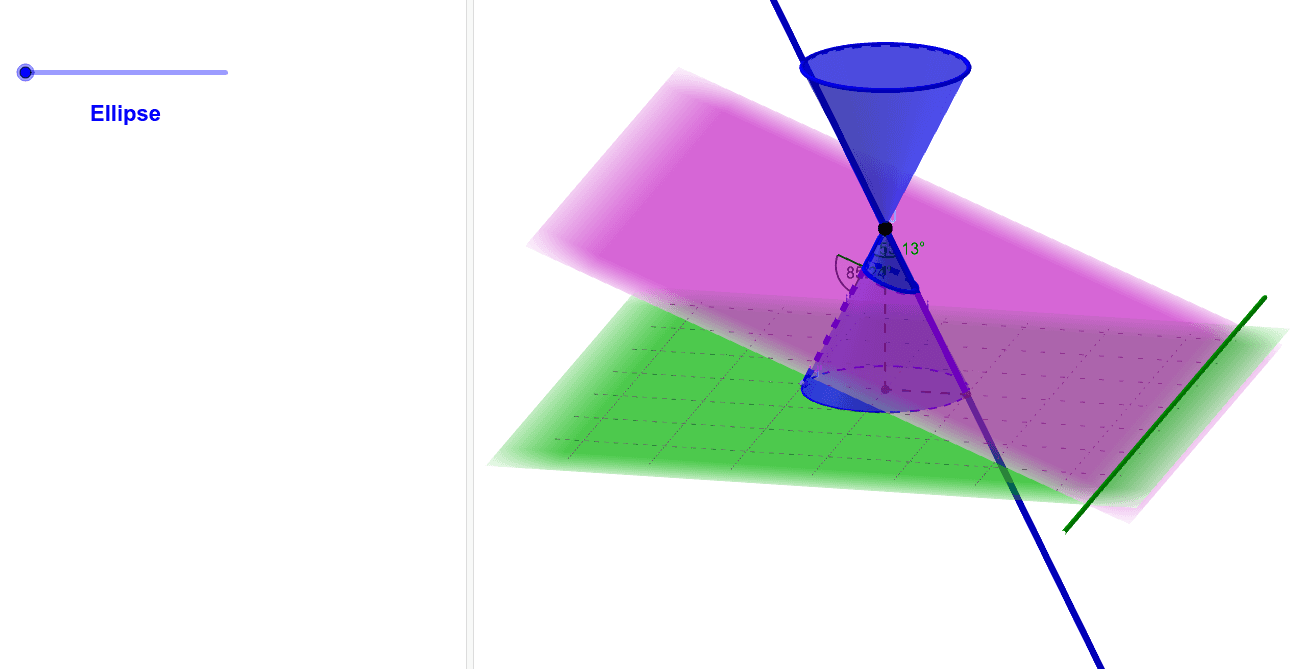
This GeoGebra example demonstrates the construction of a parabola in the Euclidean plane as the intersection of a cone and a plane, illustrating the geometric origin of quadratic function graphs. Core mathematical concepts include conic sections, parabola definition and properties, solid-plane intersection, symmetry, rotation, and angle measurement. The construction relies on GeoGebra commands such as Intersect, Cone, PointIn, and Plane to generate the conic section and key points; IntersectPath, Segment, and Point to define curve elements and auxiliary objects; and Mirror, Rotate, Angle, and Line to create reflected points, rotational transformations, angle annotations, and supporting lines. Relevant objects include points A, P, B, M, E, C, D, F, lines a, b, d, g, j, k, l, m, n, cone c, and angle labels α, β, γ. Suitable for high school and introductory college mathematics courses in analytic geometry and solid geometry, ideal for classroom demonstrations, interactive exploration, and bridging the gap between geometric loci and algebraic function representations.
GeoGebra Commands & Parameters
Intersect(zAxis, xAxis) → ACone(A, P, 2) → a, c, bPointIn(b) → BPlane(B, M, E) → eIntersectPath(e, a) → fIntersect(xAxis, f) → C,Intersect(e, c) → D, FSegment(D, F) → gIntersect(g, xAxis) → GSegment(G, B) → hPoint(xAxis) → HSegment(P, H) → iPlane((0, 0), (0, 1), (1, 2)) → jIntersectPath(j, e) → kPoint(i) → JMirror(a, J) → a'Rotate(P, 180°, J) → P'Rotate(H, 180°, J) → H'Segment(P', H') → i'Angle(i', e) → αPoint(i) → KSegment(K, A) → lSegment(J, A) → mAngle(m, i) → βIntersect(l, b, 1) → LLine(J, L) → nAngle(i', n) → γ