
Parabola as a Quadratic Function – Reinforcement Exercise #2
Loading the math board and drawing, please wait…
In collections
ECUACIONES CUADRATICAS O DE SEGUNDO ORDEN CON DOS VARIABLES
This example illustrates how a parabola can be represented as a quadratic function, providing an interactive construction to help students understand its geometric and algebraic properties. The core mathematical concepts include the vertex form and standard form of a parabola, its axis of symmetry, focus and directrix, and how parameter changes affect the graph. The GeoGebra construction uses objects c, d, e (likely coefficients or sliders) to allow real‑time manipulation of the curve. It is suitable for high‑school algebra and coordinate geometry classes, serving as a reinforcement exercise to strengthen students' grasp of quadratic functions.
GeoGebra Commands & Parameters
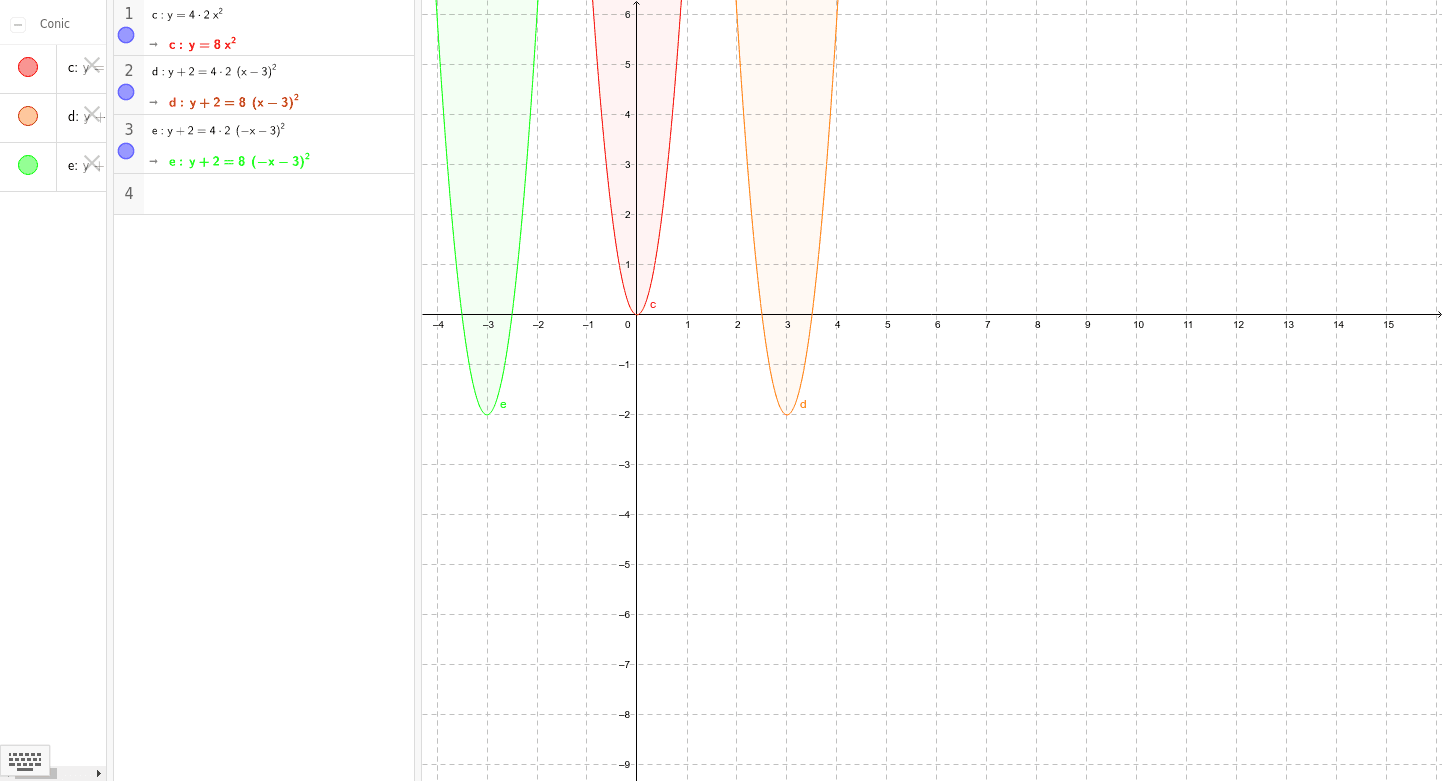
c:y = (8 * x^(2))d:y + 2 = (8 * (x - 3)^(2))e:y + 2 = (8 * ((-x) - 3)^(2))
AI Drawing Prompt Reference
Draw three upward-opening parabolas in a Cartesian coordinate system to show quadratic function translations and symmetry. The first is y=8x^2 with vertex at the origin. The second is y+2=8(x-3)^2, with vertex at (3,-2). The third is y+2=8(-x-3)^2, with vertex at (-3,-2). All three share the same quadratic coefficient 8, so they have the same shape and differ only by vertex position, illustrating horizontal shifts and symmetry about the y-axis. Include clear axes and the three curves so their vertices and equations can be compared.
The prompt above was compiled from the original drawing commands and is for reference only.