
Absolute and Reciprocal Functions Unit 9
Loading the math board and drawing, please wait…
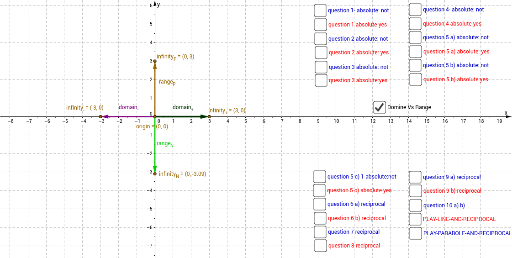
This example demonstrates the graphs of absolute value and reciprocal functions, including their intersections. Key math concepts involve functions, absolute value, reciprocals, coordinate geometry, and differential calculus. GeoGebra commands used include Point, Intersect, Vector, and OrthogonalLine, with objects like f, g, c, b_1, h_3, etc. It is suitable for high school mathematics instruction and function graph analysis.
GeoGebra Commands & Parameters
Point(b_3) → APoint(b_3) → CPoint(b_3) → DIntersect(g_1, f_1, (4.000000000000211, 0.9999999999998943)) → EIntersect(g_1, f_1, (4.7823136094842975E-17, -1)) → FPoint(p_1) → GPoint(p_1) → HPoint(p_1) → IPoint(p_1) → JPoint(r_1) → NPoint(r_1) → OPoint(r_1) → KPoint(r_1) → LPoint(s_1) → MPoint(s_1) → PPoint(s_1) → QPoint(s_1) → RIntersect(c, yAxis, 1) → SIntersect(c, xAxis, 2) → TIntersect(c, xAxis, 1) → UPoint(b_1) → VPoint(xAxis) → infinity_-Point(xAxis) → infinity_+Intersect(xAxis, yAxis) → originVector(origin, infinity_-) → domain_-Vector(origin, infinity_+) → domain_+Vector(origin, infinity_P) → range_PPoint(yAxis) → infinity_NVector(origin, infinity_N) → range_NPoint(a_2) → F_1Point(g_2) → H_1Intersect(f, xAxis) → I_1Intersect(f, yAxis) → J_1Intersect(g, yAxis, (0, 6)) → K_1Intersect(g, xAxis, (-2, 0)) → L_1Intersect(h_3, xAxis, (-2, 0)) → M_1Intersect(h_3, xAxis, (2, 0)) → N_1Intersect(p, yAxis, (0, 1)) → WIntersect(u, ((-(x(xAxis) / y(xAxis))) * x) - z(xAxis) / y(xAxis), 2) → B_1Intersect(i, xAxis) → C_1Intersect(b_3, ((-(x(xAxis) / y(xAxis))) * x) - z(xAxis) / y(xAxis), 1) → D_1Intersect(e, ((-(x(xAxis) / y(xAxis))) * x) - z(xAxis) / y(xAxis), 1) → E_1OrthogonalLine(origin, xAxis) → f_2Intersect(j, ((-(x(xAxis) / y(xAxis))) * x) - z(xAxis) / y(xAxis), 1) → G_1Intersect(j, ((-(x(xAxis) / y(xAxis))) * x) - z(xAxis) / y(xAxis), 2) → O_1Intersect(q, k_3, (2.666666666969492, 0.9999999990915249)) → P_1Intersect(q, k_3, (2.000000000002484, -1.0000000000074518)) → Q_1Intersect(l, i_2) → R_1Intersect(s, r, 1) → S_1Intersect(s, r, 2) → T_1Intersect(s, r, 2) → U_1Intersect(s, r, 2) → V_1Intersect(s, r, 2) → W_1Intersect(s, r, 2) → Z_1Point(s) → A_2Intersect(g_1, f_1, (4, 1)) → B_2Intersect(g_1, f_1, (0, -1)) → C_2Intersect(p_1, c_1, 1) → D_2Intersect(p_1, c_1, 4) → E_2Intersect(p_1, c_1, 2) → F_2Intersect(p_1, c_1, 3) → G_2Intersect(c_1, yAxis, 1) → H_2Intersect(p_1, yAxis, (0, -0.25)) → I_2Intersect(q_1, k_1, (-2, 1)) → J_2Intersect(q_1, k_1, (-4, -1)) → K_2Intersect(s_2, t_2) → L_2Intersect(r_1, d_1, 2) → M_2Intersect(r_1, d_1, 3) → N_2Intersect(r_1, d_1, 4) → O_2Intersect(r_1, d_1, 1) → P_2Intersect(r_1, l_1, (-3, 0.5)) → Q_2Intersect(d_1, l_1, 1) → R_2Intersect(d_1, n_1, 1) → S_2Intersect(d_1, m_1, 1) → T_2Intersect(s_1, e_1, 2) → U_2Intersect(s_1, e_1, 1) → V_2Intersect(s_1, e_1, 3) → W_2Intersect(s_1, e_1, 4) → Z_2Intersect(f_3, i_3, (0, 0)) → E_3Intersect(f_3, j_3, (0, 0)) → F_3Intersect(q_3, c_3, 3) → D_3Intersect(q_3, c_3, 1) → H_3Intersect(c_3, r_3, 1) → I_3Intersect(q_3, r_3, (-1.1, 0.5882352941176471)) → J_3Intersect(c_3, s_3, 1) → K_3Intersect(c_3, s_3, 2) → L_3Intersect(c_3, t_3, 2) → M_3Intersect(c_3, s_3, 2) → N_3Point(p) → Q_3Point(p) → R_3Intersect(c_3, d_3, 2) → ZIntersect(c_3, d_3, 1) → A_1OrthogonalLine(Z, a_3) → f_4OrthogonalLine(A_1, a_3) → g_4