
Oscar's Parallelogram, Rhombus, Rectangle, Square, Kite, Trapezoid
Loading the math board and drawing, please wait…
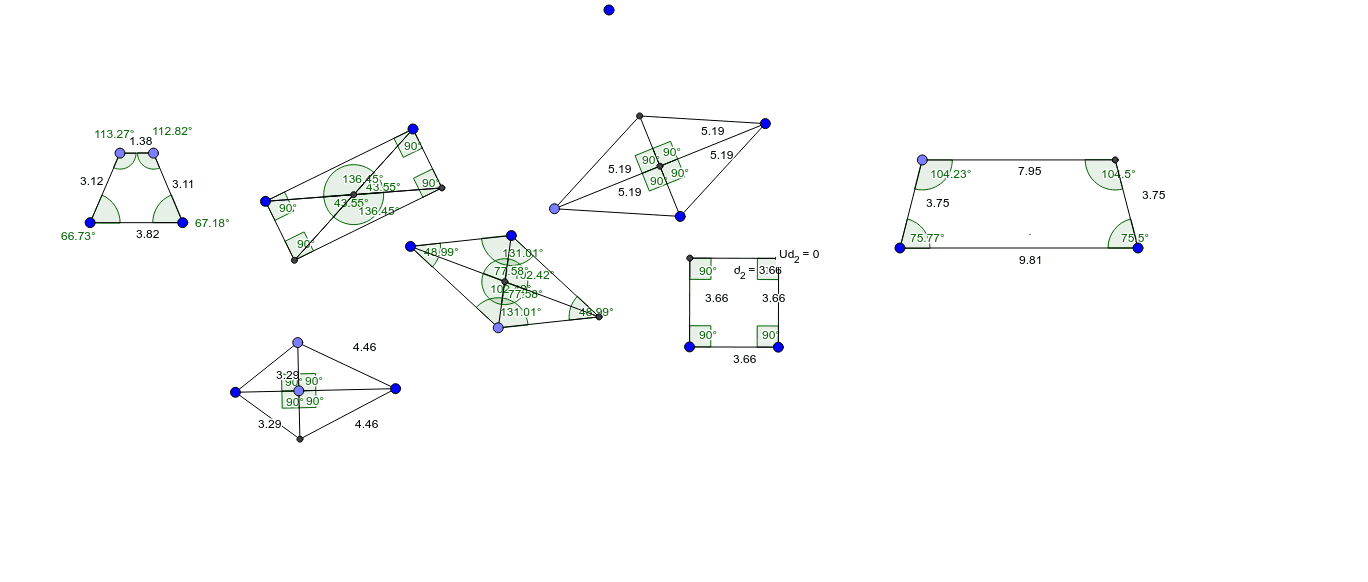
This example demonstrates Oscar's parallelogram, rhombus, rectangle, square, kite, and trapezoid. It involves key mathematical concepts such as geometric construction, angles, and distances. Using GeoGebra commands like Line, Point, Segment, Intersect, Angle, Circle, etc., these shapes can be constructed. Suitable for middle and high school students learning geometric construction and related concepts.
GeoGebra Commands & Parameters
Line(A, B) → aLine(C, a) → bPoint(b) → DSegment(A, D) → cLine(B, c) → dIntersect(d, b) → ESegment(B, E) → eSegment(A, B) → fSegment(E, D) → gAngle(A, B, E) → αAngle(B, E, D) → βAngle(E, D, A) → γAngle(D, A, B) → δSegment(B, D) → hSegment(A, E) → iIntersect(i, h) → FAngle(A, F, D) → εAngle(D, F, E) → ζAngle(E, F, B) → ηAngle(B, F, A) → θCircle(G, H) → kPoint(k) → ICircle(I, G) → pCircle(H, G) → qIntersect(p, q, 2) → JSegment(I, J) → jSegment(J, H) → lSegment(H, G) → mSegment(G, I) → nSegment(J, G) → rSegment(I, H) → sIntersect(r, s) → KSegment(I, K) → tSegment(K, H) → a_1Segment(J, K) → b_1Segment(K, G) → c_1Angle(H, K, J) → ιAngle(G, K, H) → κAngle(I, K, G) → λAngle(J, K, I) → μSegment(L, M) → d_1Line(N, d_1) → e_1OrthogonalLine(L, e_1) → f_1Intersect(f_1, e_1) → OOrthogonalLine(M, e_1) → g_1Intersect(e_1, g_1) → PSegment(L, O) → h_1Segment(O, P) → i_1Segment(P, M) → j_1Angle(O, L, M) → νAngle(L, M, P) → ξAngle(M, P, O) → οAngle(P, O, L) → ρSegment(M, O) → k_1Segment(L, P) → l_1Intersect(l_1, k_1) → QSegment(M, Q) → m_1Segment(Q, L) → n_1Segment(Q, O) → p_1Segment(Q, P) → q_1Angle(L, Q, O) → σAngle(O, Q, P) → τAngle(P, Q, M) → υAngle(M, Q, L) → ϕSegment(R, S) → r_1OrthogonalLine(R, r_1) → s_1OrthogonalLine(S, r_1) → t_1Circle(R, S) → c_2Intersect(c_2, s_1, 2) → TOrthogonalLine(T, s_1) → a_2Intersect(t_1, a_2) → USegment(R, T) → b_2Segment(T, U) → d_2Segment(U, S) → e_2Angle(R, T, U) → χAngle(T, U, S) → ψAngle(U, S, R) → ωAngle(S, R, T) → α_1Segment(V, W) → f_2Point(f_2) → ZOrthogonalLine(Z, f_2) → g_2Point(g_2) → A_1Circle(Z, A_1) → h_2Intersect(h_2, g_2, 2) → B_1Point(h_2) → C_1Segment(V, A_1) → i_2Segment(V, B_1) → j_2Segment(B_1, W) → k_2Segment(W, A_1) → l_2Segment(D_1, E_1) → m_2Point(m_2) → F_1OrthogonalLine(F_1, m_2) → n_2Point(n_2) → G_1Circle(F_1, G_1) → p_2Intersect(p_2, n_2, 2) → H_1Segment(D_1, G_1) → q_2Segment(D_1, H_1) → r_2Segment(H_1, E_1) → s_2Segment(E_1, G_1) → t_2Segment(I_1, J_1) → a_3OrthogonalLine(I_1, a_3) → b_3OrthogonalLine(J_1, a_3) → c_3Point(b_3) → K_1OrthogonalLine(K_1, b_3) → d_3Intersect(c_3, d_3) → L_1Segment(K_1, L_1) → e_3Point(e_3) → M_1Segment(I_1, M_1) → f_3Circle(J_1, f) → g_3Intersect(g_3, e_3, 1) → N_1Segment(J_1, N_1) → h_3Segment(M_1, N_1) → i_3Segment(O_1, P_1) → j_3OrthogonalLine(O_1, j_3) → k_3OrthogonalLine(P_1, j_3) → l_3Point(k_3) → Q_1OrthogonalLine(Q_1, k_3) → m_3Intersect(l_3, m_3) → R_1Segment(Q_1, R_1) → n_3Point(n_3) → S_1Segment(O_1, S_1) → p_3Circle(P_1, 3.08) → q_3Circle(P_1, 3.124410319967215) → r_3Point(r_3) → T_1Circle(P_1, 6.95) → s_3Circle(P_1, 6.919440774045372) → t_3Point(s_3) → U_1Circle(P_1, 6.962364924165079) → c_4Point(Circle[V_1, 9]) → W_1Segment(V_1, W_1) → a_4Line(Z_1, a_4) → b_4Point(b_4) → A_2Segment(V_1, A_2) → d_4Circle(W_1, 6.83) → e_4Intersect(e_4, b_4, 1) → B_2Segment(W_1, B_2) → f_4Segment(A_2, B_2) → g_4Segment(C_2, D_2) → h_4OrthogonalLine(C_2, h_4) → i_4OrthogonalLine(D_2, h_4) → j_4Point(i_4) → E_2OrthogonalLine(E_2, i_4) → k_4Intersect(j_4, k_4) → F_2Segment(E_2, F_2) → l_4Point(l_4) → G_2Point(l_4) → H_2Point(l_4) → J_2Segment(G_2, J_2) → m_4Segment(C_2, G_2) → n_4Segment(D_2, J_2) → p_4Segment(D_1, E_1) → q_4Segment(G_1, H_1) → r_4Segment(D_1, F_1) → s_4Segment(F_1, E_1) → t_4Segment(G_1, F_1) → a_5Segment(F_1, H_1) → b_5Angle(G_1, F_1, E_1) → β_1Angle(E_1, F_1, G_1) → γ_1Angle(H_1, F_1, E_1) → δ_1Angle(D_1, F_1, H_1) → ε_1Angle(G_1, F_1, D_1) → ζ_1Distance(q_2, t_2) → oDistance(U, d_2) → distanceUd2Segment(K_2, L_2) → c_5OrthogonalLine(M_2, c_5) → d_5OrthogonalLine(K_2, c_5) → e_5OrthogonalLine(L_2, c_5) → f_5Point(e_5) → N_2OrthogonalLine(O_2, e_5) → g_5OrthogonalLine(N_2, e_5) → h_5Intersect(f_5, h_5) → P_2Segment(N_2, P_2) → i_5Point(i_5) → Q_2Point(i_5) → R_2Point(i_5) → S_2Segment(Q_2, K_2) → j_5Segment(Q_2, R_2) → k_5Segment(R_2, L_2) → l_5Angle(K_2, Q_2, R_2) → η_1Angle(Q_2, R_2, L_2) → θ_1Angle(R_2, L_2, K_2) → ι_1Angle(L_2, K_2, Q_2) → κ_1Segment(T_2, U_2) → m_5OrthogonalLine(T_2, m_5) → n_5OrthogonalLine(U_2, m_5) → p_5Point(n_5) → V_2OrthogonalLine(V_2, p_5) → q_5Intersect(p_5, q_5) → W_2Segment(R_2, Z_2) → r_5Point(r_5) → A_3Segment(A_3, B_3) → s_5Segment(V_2, W_2) → t_5Point(t_5) → D_3Segment(D_3, T_2) → a_6Circle(U_2, 3.07) → c_6Intersect(c_6, t_5, 1) → E_3Segment(E_3, U_2) → b_6Segment(D_3, E_3) → d_6Circle(U_2, 3.07) → e_6Segment(E_3, U_2) → f_6Segment(F_3, G_3) → g_6OrthogonalLine(F_3, g_6) → h_6OrthogonalLine(G_3, g_6) → i_6Point(h_6) → H_3OrthogonalLine(H_3, h_6) → j_6Intersect(i_6, j_6) → I_3Segment(H_3, I_3) → k_6Point(k_6) → J_3Segment(F_3, J_3) → l_6Circle(G_3, 3.76) → p_6Intersect(p_6, k_6, 1) → K_3Segment(G_3, K_3) → m_6Segment(J_3, K_3) → n_6Angle(F_3, J_3, K_3) → λ_1Angle(J_3, K_3, G_3) → μ_1Angle(K_3, G_3, F_3) → ν_1Angle(G_3, F_3, J_3) → ξ_1Point(Circle[L_3, 9]) → M_3Segment(L_3, M_3) → q_6Line(N_3, q_6) → r_6Point(r_6) → O_3Segment(L_3, O_3) → s_6Circle(M_3, 6.83) → t_6Intersect(t_6, r_6, 1) → P_3Segment(M_3, P_3) → a_7Segment(O_3, P_3) → b_7Segment(Q_3, R_3) → c_7OrthogonalLine(Q_3, c_7) → d_7OrthogonalLine(R_3, c_7) → e_7Point(d_7) → S_3OrthogonalLine(S_3, d_7) → f_7Intersect(e_7, f_7) → T_3Segment(S_3, T_3) → g_7Point(g_7) → U_3Segment(Q_3, U_3) → h_7Circle(R_3, 3.75) → k_7Intersect(k_7, g_7, 1) → V_3Segment(R_3, V_3) → i_7Segment(U_3, V_3) → j_7Angle(Q_3, U_3, V_3) → ο_1Angle(U_3, V_3, R_3) → ρ_1Angle(V_3, R_3, Q_3) → σ_1Angle(R_3, Q_3, U_3) → τ_1
AI Drawing Prompt Reference
Draw a parallelogram first, then construct a rhombus, rectangle, square, kite, and trapezoid based on it. Start by drawing two intersecting lines AB and BC, then draw a line parallel to AB through point B, intersecting BC at point D, and connect AD and BD to form parallelogram ABCD. Next, draw a circle with center D and radius DA, intersecting AB at point E, and connect BE to form rhombus ABED. Then, draw a circle with center E and radius EA, intersecting BD at point F, and connect EF to form rectangle ABEF. After that, draw a circle with center F and radius FA, intersecting BE at point G, and connect FG to form square ABEF. Then, draw a circle with center G and radius GA, intersecting EF at point H, and connect GH to form kite ABGH. Finally, draw a circle with center H and radius HA, intersecting FG at point I, and connect HI to form trapezoid ABHI.
The prompt above was compiled from the original drawing commands and is for reference only.