
Orthocenter Divides Altitudes to Create Equal Products
Loading the math board and drawing, please wait…
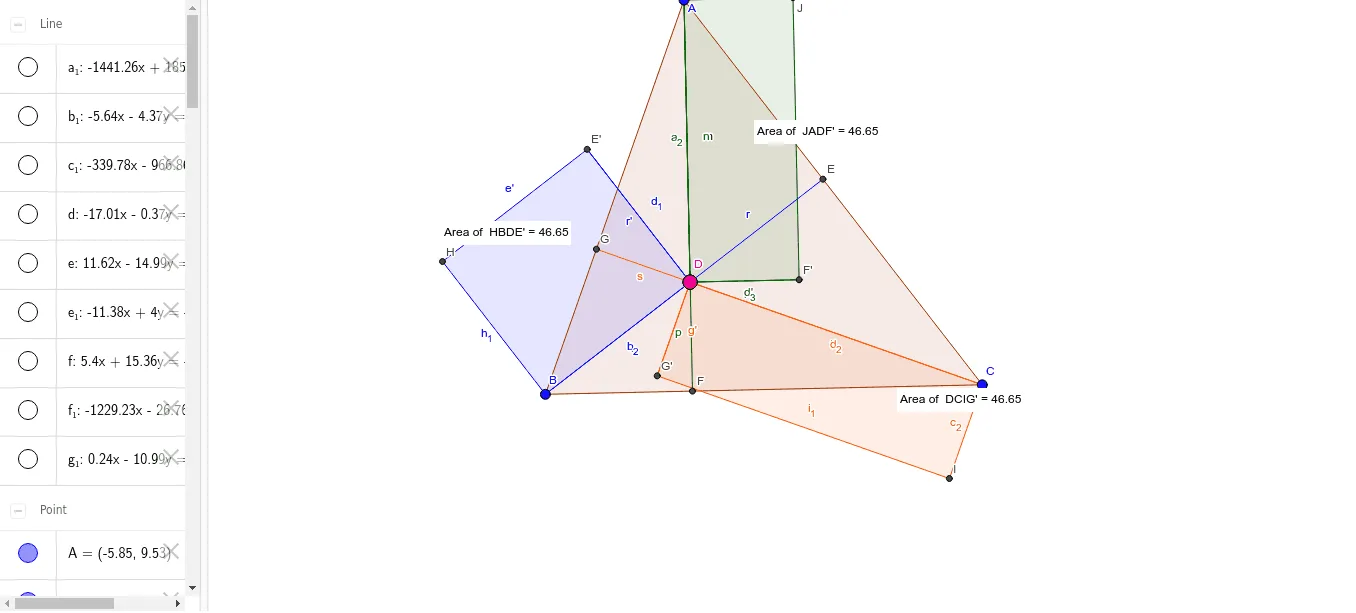
This example demonstrates how the orthocenter of a triangle divides altitudes to create equal products. Key mathematical concepts include the properties of altitudes and orthocenters. Using GeoGebra commands such as Polygon, OrthogonalLine, Intersect, Segment, Rotate, and PointIn, a dynamic geometric figure is constructed. Suitable for middle school and above students to learn triangle geometry.
GeoGebra Commands & Parameters
Polygon(A, B, C) → poly1, c, a, bOrthogonalLine(A, a) → dOrthogonalLine(B, b) → eOrthogonalLine(C, c) → fIntersect(d, e) → DSegment(B, D) → gSegment(D, C) → hSegment(D, A) → iIntersect(e, b) → ESegment(B, E) → jIntersect(d, a) → FSegment(A, F) → kIntersect(f, c) → GSegment(C, G) → lSegment(D, A) → mSegment(D, A) → nSegment(D, F) → pSegment(B, D) → qSegment(E, D) → rSegment(G, D) → sSegment(D, C) → tRotate(E, 90°, D) → E'Rotate(D, 90°, D) → D'Segment(E', D') → r'Rotate(G, 90°, D) → G'Rotate(D, 90°, D) → D'_1Segment(G', D'_1) → s'Rotate(D, 90°, D) → D'_2Rotate(F, 90°, D) → F'Segment(D'_2, F') → p'OrthogonalLine(E', r') → a_1OrthogonalLine(B, q) → b_1Intersect(a_1, b_1) → HPolygon(H, B, D, E') → poly2, h_1, b_2, d_1, e'OrthogonalLine(G', s') → c_1OrthogonalLine(C, t) → e_1Intersect(c_1, e_1) → IPolygon(D, C, I, G') → poly3, d_2, c_2, i_1, g'OrthogonalLine(F', p') → f_1OrthogonalLine(A, m) → g_1Intersect(f_1, g_1) → JPolygon(J, A, D, F') → poly4, j_1, a_2, d_3, f'PointIn(poly2) → Pointpoly2PointIn(poly4) → Pointpoly4PointIn(poly3) → Pointpoly3
AI Drawing Prompt Reference
Draw a triangle ABC, then drop perpendiculars from A, B, and C to the opposite sides, intersecting at points D, E, and F. Connect DE, DF, and EF, and observe how D divides these segments such that DE·DF = BE·EF = CF·CD. Then, rotate the perpendiculars around point D to form new triangles and observe how the perpendicular intersections H, I, and J relate to the original triangle's vertices.
The prompt above was compiled from the original drawing commands and is for reference only.