
Operations of Three Sets #2: Union, Intersection, Complement, Difference with Ve
Loading the math board and drawing, please wait…
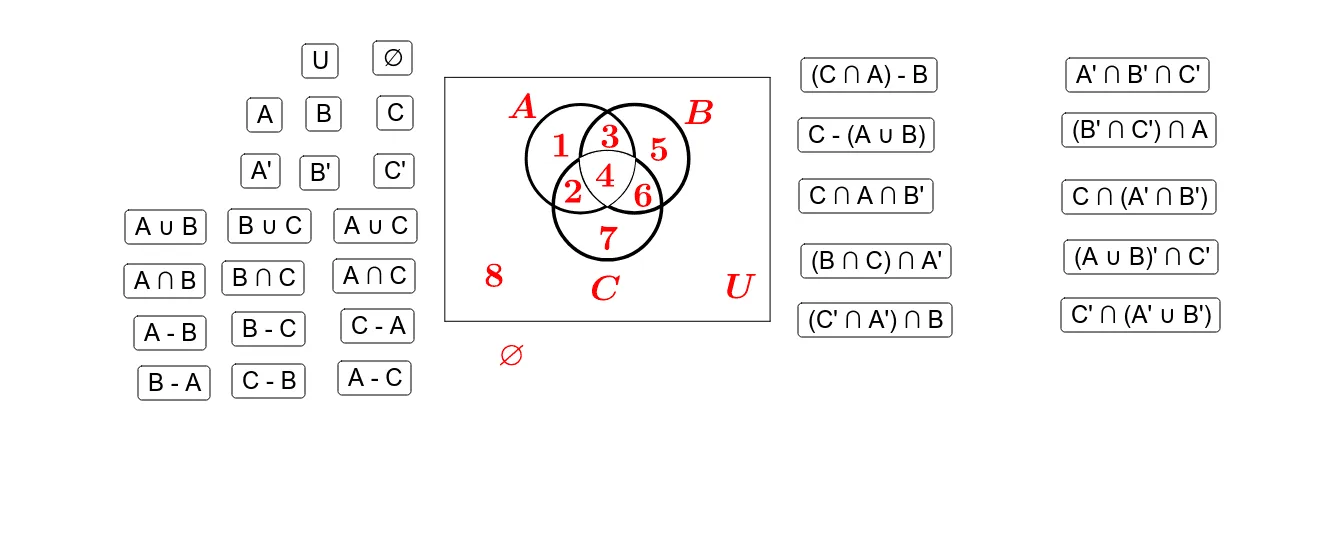
This GeoGebra example dynamically demonstrates operations on three sets, including union, intersection, complement, and difference, visualized through a Venn-Euler diagram. The core mathematical concepts involve set theory fundamentals, set operations, and the partitioning of regions to represent logical relationships. The construction uses GeoGebra commands such as Polygon, Circle, Intersect, CircleSector, and Segment to create three overlapping circular regions, with points defining key vertices and objects labeled A1 through A30 marking distinct set areas. This interactive diagram is suitable for middle school, high school, or introductory college courses in discrete mathematics, helping students grasp the geometric interpretation of set operations and enhance their logical reasoning skills.
GeoGebra Commands & Parameters
Polygon(A, B, C, D) → Universe, a, b, c, dPoint(yAxis) → CenterACircle(CenterA, F) → CircleAPoint(CircleA) → CenterBCircle(CenterB, CenterA) → CircleBIntersect(CircleA, CircleB, 2) → CenterCCircle(CenterC, CenterA) → CircleCIntersect(CircleA, CircleB, 1) → ECircleSector(CenterA, CenterC, E) → AB1CircleSector(CenterB, E, CenterC) → AB2Intersect(CircleA, CircleC, 2) → GCircleSector(CenterA, G, CenterB) → AC1CircleSector(CenterC, CenterB, G) → AC2Intersect(CircleB, CircleC, 2) → HCircleSector(CenterC, H, CenterA) → BC1CircleSector(CenterB, CenterA, H) → BC2Circle(CenterA, F) → eCircle(CenterB, CenterA) → fCircle(CenterC, CenterA) → gSegment(A, B) → hSegment(B, C) → iSegment(C, D) → jSegment(D, A) → kCircleSector(CenterC, CenterB, CenterA) → ABC1CircleSector(CenterB, CenterA, CenterC) → ABC2CircleSector(CenterA, CenterC, CenterB) → ABC3