
Nets of Pyramids
Loading the math board and drawing, please wait…
In collections
Geometry-Volume and Surface Area
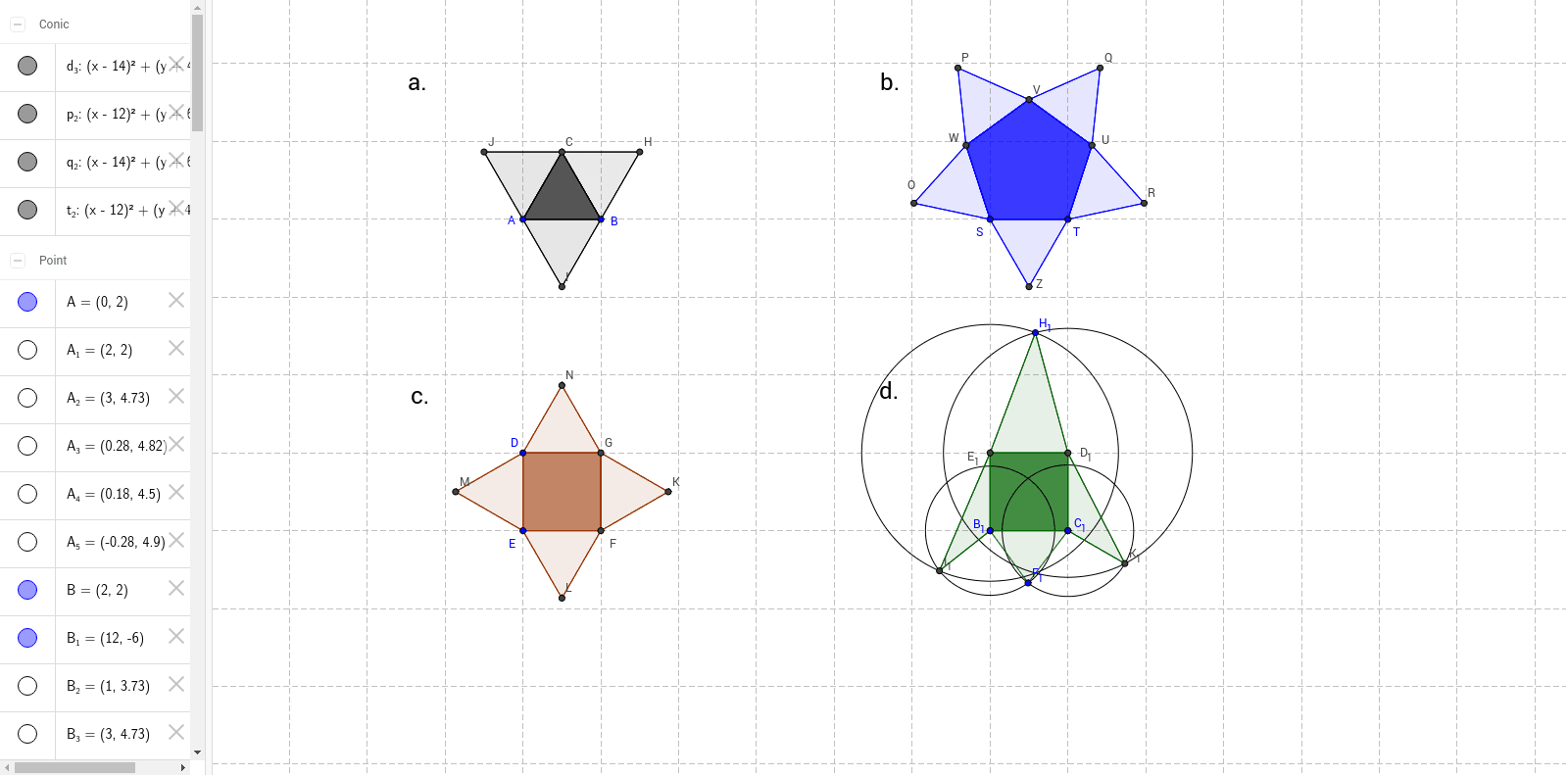
This example demonstrates the construction of four different nets of pyramids. It involves core mathematical concepts such as polygon construction, rotation, and intersection. Key GeoGebra commands and objects used include Polygon, Rotate, Circle, Segment, and Intersect. Suitable for high school students learning solid geometry to understand the relationship between 3D shapes and their 2D nets.
GeoGebra Commands & Parameters
Polygon(A, B, 3) → poly1, a, b, c, CPolygon(D, E, 4) → poly2, d, e, f, g, F, GPolygon(C, B, 3) → poly3, h, i, j, HPolygon(B, A, 3) → poly4, k, l, m, IPolygon(A, C, 3) → poly5, n, p, q, JPolygon(S, T, 5) → poly10, n_1, p_1, q_1, r_1, s_1, U, V, WPolygon(G, F, 3) → poly6, r, s, t, KPolygon(F, E, 3) → poly7, a_1, b_1, c_1, LPolygon(E, D, 3) → poly8, d_1, e_1, f_1, MPolygon(D, G, 3) → poly9, g_1, h_1, i_1, NPolygon(S, W, 3) → poly11, j_1, k_1, l_1, OPolygon(W, V, 3) → poly12, m_1, t_1, a_2, PPolygon(V, U, 3) → poly13, b_2, c_2, d_2, QPolygon(U, T, 3) → poly14, e_2, f_2, g_2, RPolygon(T, S, 3) → poly15, h_2, i_2, j_2, ZPolygon(B_1, C_1, 4) → poly16, k_2, l_2, m_2, n_2, D_1, E_1Polygon(B_4, C_2, 4) → poly16_1, k_3, l_3, m_3, n_3, D_2, E_2Polygon(B_1, F_1, C_1) → poly17, c_3, b_3, f_3Rotate(B_1, 270*°, B_1) → G_1Rotate(C_1, 90*°, C_1) → J_1Circle(B_1, F_1) → p_2Circle(C_1, F_1) → q_2Segment(E_1, H_1) → r_2Segment(D_1, H_1) → s_2Circle(E_1, H_1) → t_2Circle(D_1, H_1) → d_3Intersect(p_2, t_2, 1) → I_1Intersect(q_2, d_3, 2) → K_1Segment(E_1, I_1) → a_3Segment(I_1, B_1) → e_3Segment(D_1, K_1) → g_3Segment(C_1, K_1) → h_3Polygon(E_1, D_1, H_1) → poly18, h_4, e_4, d_4Polygon(I_1, B_1, E_1) → poly19, e_5, i_3, b_4Polygon(C_1, K_1, D_1) → poly20, d_5, c_4, k_4
AI Drawing Prompt Reference
Draw four different nets of pyramids to demonstrate core mathematical concepts like polygon construction, rotation, and intersection. Start by creating multiple regular polygons for the bases and faces of the pyramids, then use rotation and intersection to construct the nets, and finally combine all parts into a complete pyramid net to understand the relationship between 3D shapes and their 2D unfoldings.
The prompt above was compiled from the original drawing commands and is for reference only.