
Net of a Cube by Rachel Birtles
Loading the math board and drawing, please wait…
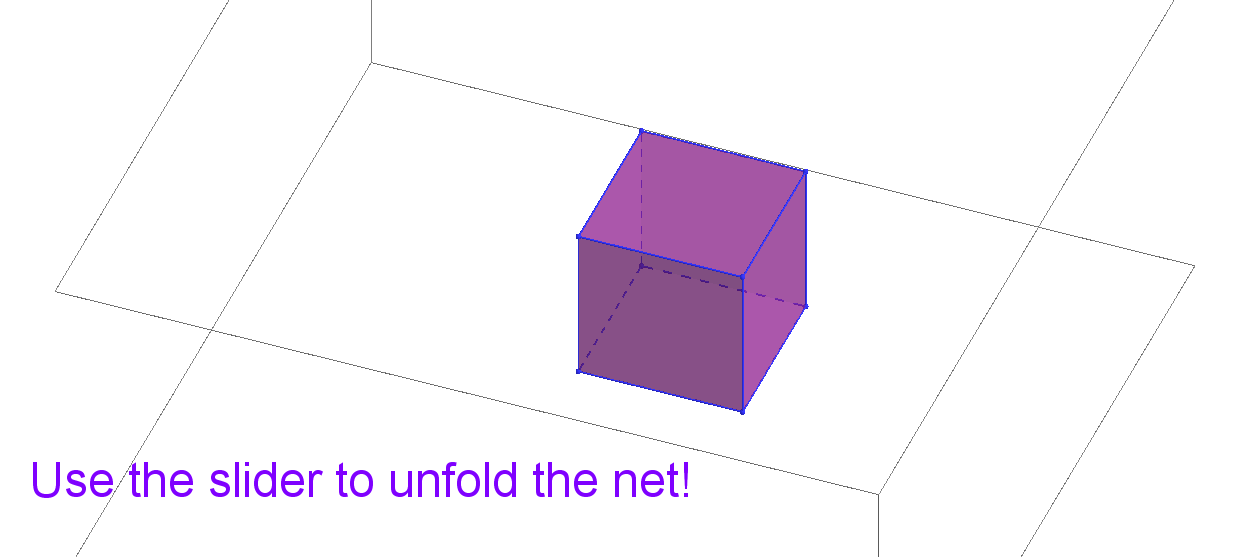
This GeoGebra example demonstrates the construction of a cube net, illustrating the relationship between three-dimensional and two-dimensional representations of solid geometry. Key mathematical concepts include solid geometry, surface area, and polyhedron nets. The construction utilizes GeoGebra commands such as Point, Cube, Net, and defines faces (faceABCD, faceADHE, etc.) and edges. It is suitable for middle and high school geometry education, supporting visual and interactive learning of spatial reasoning and area calculation.
GeoGebra Commands & Parameters
Point(Circle[B, Distance[A, B], Segment[A, B]]) → CCube(A, B, C) → a, D, faceCDHG, faceEFGH, edgeAD, edgeAB, edgeBC, edgeCD, edgeAE, edgeDH, edgeEH, edgeEF, E, edgeBF, edgeFG, edgeCG, edgeGH, F, G, H, faceABCD, faceADHE, faceABFE, faceBCGFNet(a, c) → d, I, R, S, T, U, V, faceIJKL, faceILNM, faceIJRQ, faceJKTS, faceKLVU, J, faceMNOP, edgeIL, edgeIJ, edgeJK, edgeKL, edgeLN, edgeMN, edgeIM, edgeIQ, edgeQR, K, edgeJR, edgeJS, edgeST, edgeKT, edgeKU, edgeUV, edgeLV, edgeNO, edgeOP, edgeMP, L, M, N, O, P, Q
AI Drawing Prompt Reference
Draw a net of a cube, showing its 2D flat layout with connected square faces that can be folded into a 3D cube, highlighting the relationship between the surface area and spatial geometry, suitable for educational purposes to demonstrate the conversion between 3D and 2D shapes.
The prompt above was compiled from the original drawing commands and is for reference only.