
Net of a Cone by GeoGebra Materials Team
Loading the math board and drawing, please wait…
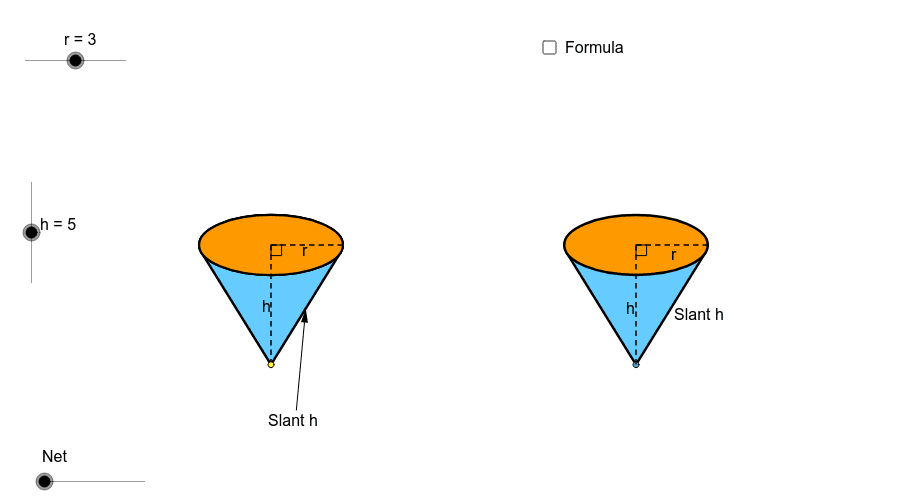
This GeoGebra example demonstrates the net of a cone through an animation, showing the process of unfolding a cone's lateral surface into a flat plane. Key mathematical concepts include solid geometry properties of cones, the geometry of nets, parametric curves, and vector transformations. The construction utilizes GeoGebra commands such as Point, Circle, Intersect, Ellipse, Vector, Translate, Arc, and Segment, involving objects like points, circles, and vectors to build the net step by step. It is suitable for high school or college-level mathematics education, particularly in solid geometry courses to visualize 3D shapes and their developments.
GeoGebra Commands & Parameters
Point(xAxis) → ACircle(A, r) → cIntersect(c, xAxis) → B, CEllipse(E, D, C) → eIntersect(xAxis, yAxis) → FVector(F, G) → uTranslate(B, Vector[u * h]) → B'_1Translate(C, Vector[u * h]) → C'_1Translate(A, Vector[u * h]) → A'_1Translate(e, Vector[u * h]) → e'_1Arc(e'_1, C'_1, B'_1) → p_5Arc(e'_1, B'_1, C'_1) → qSegment(A'_1, A) → h_6Segment(A'_1, C'_1) → pAngle(A, A'_1, C'_1) → αLine(A, A'_1) → jIntersect(e'_1, j) → H, ICircle(I, r) → tIntersect(t, j, 2.0) → KCircle(K, I) → d_1Intersect(d_1, j, 2.0) → NVector(H, N) → vTranslate(H, Vector[v * n]) → H'_1Translate(D, Vector[u * h]) → D'Translate(E, Vector[u * h]) → E'Line(B, B'_1) → lLine(C, C'_1) → mIntersect(d_1, l, 1.0) → PIntersect(d_1, m, 1.0) → QVector(B'_1, P) → zVector(C'_1, Q) → u_1Translate(B'_1, Vector[z * n]) → B''Translate(C'_1, Vector[u_1 * n]) → C''Midpoint(B'_1, A'_1) → RMidpoint(B, A) → SLine(R, S) → a_1Intersect(q, a_1) → T,Intersect(d_1, a_1, 1.0) → UVector(T, U) → v_1Translate(T, Vector[v_1 * n]) → T'If(n < 1.0, B'', P) → B_1If(n < 1.0, T', U) → D_1If(n < 1.0, H'_1, N) → E_1If(n < 1.0, C'', Q) → F_1Conic(B_1, D_1, E_1, F_1, I) → g_1Conic(I, B_1, D_1, E_1, F_1) → h_1OrthogonalLine(I, j) → l_1OrthogonalLine(H, j) → b_2Intersect(m, l_1) → H_2Midpoint(H_2, C'_1) → I_2OrthogonalLine(C'_1, m) → i_2Segment(K, F_1) → m_4Translate(e, Vector[u * h]) → e'Tangent(A, e'_1) → a, bIntersect(e', b) → J, G_2Intersect(e', a) → L, R_2Segment(A, J) → fSegment(A, L) → gCircle(I, sqrt(h^(2.0) + r^(2.0))) → kIntersect(k, j, 1.0) → MCircle(M, sqrt(h^(2.0) + r^(2.0))) → sSegment(M, I) → iRotate(I, γ, M) → I'_1Rotate(I, -(γ), M) → I'_2OrthogonalLine(I'_2, i_2) → b_1Intersect(b_2, b_1) → OMidpoint(H, O) → VCircle(V, O) → c_1Vector(O, I'_2) → wCenter(g_1) → WSegment(W, F_1) → e_1Vector(H, A) → w_1Translate(H, Vector[w_1 * (n - 1.0)]) → H'If(n < 1.0, H, If[n < 2.0, H', A]) → ZSegment(H, Z) → f_1Rotate(I, -(δ), M) → I'Vector(L, I') → z_1Translate(c_1, Vector[w * (n - 2.0)]) → k_1Center(k_1) → A_1Intersect(k_1, j) → C_1, Q_1Rotate(C_1, 180.0° * (n - 2.0), A_1) → G_1If(n < 2.0, H, If[n ≤ 3.0, G_1, I'_2]) → H_1Mirror(H_1, j) → I_1Translate(L, Vector[z_1 * (n - 2.0)]) → L'If(n < 2.0, L, If[n ≤ 3.0, L', I']) → J_1Mirror(J_1, j) → K_1Conic(I_1, H_1, J_1, I, K_1) → p_1Vector(A, M) → i_1Translate(A, Vector[i_1 * (n - 2.0)]) → A'If(n < 2.0, A, If[n ≤ 3.0, A', M]) → L_1Tangent(L_1, p_1) → j_1, m_1Intersect(p_1, m_1, 1.0) → M_1Intersect(p_1, j_1, 1.0) → N_1Polygon(L_1, M_1, N_1) → poly1, n_1, l_2, m_2Arc(p_1, N_1, M_1) → q_1Line(L_1, b_2) → r_1Intersect(p_1, r_1, 1.0) → O_1Intersect(p_1, r_1, 2.0) → P_1Arc(p_1, P_1, O_1) → s_1Polygon(L_1, O_1, I_1) → poly2, i_3, l_3, o_1Polygon(L_1, H_1, P_1) → poly3, p_2, l_4, h_2Arc(p_1, O_1, I_1) → t_1Arc(p_1, H_1, P_1) → c_2Segment(L_1, I_1) → a_2Segment(L_1, H_1) → d_2Arc(p_1, H_1, I_1) → e_2Polygon(I_1, L_1, H_1) → poly4, h_3, i_4, l_5CircleSector(M, I'_2, I'_1) → f_2CircleSector(M, I'_2, I'_1) → g_2Arc(p_1, H_1, I_1) → k_2Segment(M_1, L_1) → j_2Segment(N_1, L_1) → n_2Polygon(I_1, L_1, H_1) → poly5, h_4, i_5, l_6Arc(p_1, H_1, I_1) → q_2Polygon(J, A, L) → poly6, l_7, j_3, a_3Point(xAxis) → R_1OrthogonalLine(R_1, xAxis) → r_2Intersect(i_2, r_2) → S_1Circle(R_1, r) → s_2Intersect(s_2, xAxis) → T_1, U_1OrthogonalLine(T_1, i_2) → t_2OrthogonalLine(V_1, i_2) → b_3OrthogonalLine(W_1, i_2) → c_3Intersect(i_2, t_2) → Z_1Intersect(i_2, b_3) → A_2Intersect(i_2, c_3) → B_2Ellipse(A_2, B_2, Z_1) → d_3Tangent(R_1, d_3) → e_3, f_3Intersect(d_3, f_3, 1.0) → C_2Intersect(d_3, e_3, 1.0) → D_2Polygon(C_2, D_2, R_1) → poly7, r_3, c_4, d_4Ellipse(A_2, B_2, Z_1) → g_3OrthogonalLine(U_1, xAxis) → k_3Intersect(g_3, k_3) → E_2, J_2Segment(S_1, E_2) → m_3Segment(S_1, R_1) → n_3Intersect(d_3, m_3, 1.0) → F_2Midpoint(g) → K_2Midpoint(f_1) → L_2Point(j) → M_2Midpoint(I_1, A') → N_2Midpoint(A', H_1) → O_2Vector(M_2, N_2) → u_2Vector(M_2, O_2) → v_2Line(M_2, r_1) → p_3Point(p_3) → P_2Vector(P_2, K_2) → z_2Vector(P_2, L_2) → u_3Center(g_3) → Q_2Angle(F_2, Q_2, R_1) → εSegment(I_1, H_1) → q_3Intersect(k_2, q_3, 2.0) → S_2
AI Drawing Prompt Reference
Draw the net of a cone, starting by drawing a circle c centered at point A, intersecting the x-axis at points B and C. Then draw an ellipse e intersecting the x-axis and y-axis at points F and G. Translate points B, C, A, and ellipse e along vector u by h units to form new points B'1, C'1, A'1, and e'1. Draw arcs p_5 and q connecting points B'1 and C'1, and A'1 and C'1. Draw line j intersecting ellipse e'1 at points H and I, and draw circle t intersecting line j at point K, then draw arc d_1 intersecting line j at point N. Translate point H along vector v by n units to form point H'1, then translate points D and E along vector u by h units to form new points D' and E'. Draw lines l and m intersecting arc d_1 at points P and Q, draw vectors z and u_1, translate point B'1 along vector z by n units to form point B'', and translate point C'1 along vector u_1 by n units to form point C''. Draw line a_1 intersecting arc d_1 at points T and U, draw vector v_1, and translate point T along vector v_1 by n units to form point T'. Finally, choose one of points B'', P, N, or Q based on the condition to form the cone's net.
The prompt above was compiled from the original drawing commands and is for reference only.