
My First GeoGebra Math Exploration: Random Sequences Interacting with Geometric
Loading the math board and drawing, please wait…
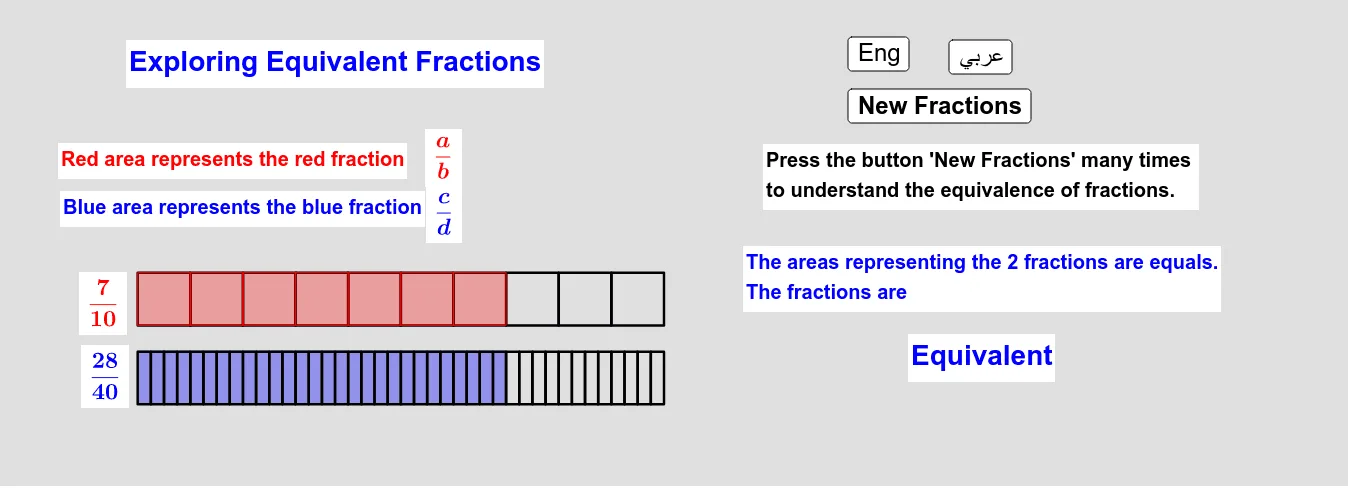
This example demonstrates an interactive mathematical exploration environment that combines random number generation, sequence construction, and various geometric objects such as ellipses, kites, and planes. The core mathematical concepts include fractions, ellipses, planes, integral calculus, and foundational calculus ideas, along with dynamic sequences generated through random functions and conditional logic (If). The construction uses GeoGebra commands like Random, If, and Sequence, and involves numerous text, button, and list objects (e.g., list1, list5) for interactive control, including language switching buttons (Eng, Arab). It is suitable for upper secondary or early university students to explore the integration of stochastic processes with geometry and calculus, and serves as an introductory example for teachers demonstrating dynamic mathematical models.
GeoGebra Commands & Parameters
Random(2, 10) → bRandom(0, 1) → eRandom(1, b - 1) → aRandom(2, 4) → mIf(e ≟ 0, (a * m), a) → cSequence(Rectangle[20 / d, ((k * 20 / d), -1), ((k * 20 / d), -3)], k, 0, d - 1) → list5Sequence(Rectangle[20 / b, ((k * 20 / b), 2), ((k * 20 / b), 0)], k, 0, b - 1) → list1Sequence(Rectangle[20 / b, ((k * 20 / b), 2), ((k * 20 / b), 0)], k, 0, a - 1) → list2Sequence(Rectangle[20 / d, ((k * 20 / d), -1), ((k * 20 / d), -3)], k, 0, c - 1) → list3
AI Drawing Prompt Reference
Create an interactive math exploration scene with two sets of rectangular strips at the top, one set descending from the top and another from the middle, representing different fractional divisions. Below, two more sets of rectangular strips run in opposite directions, creating a symmetric visual contrast. All strips have uniform width, but their counts are determined by random numbers, with some strips conditionally hidden. In the center or side, place an ellipse, a kite-shaped polygon, and a plane as geometric accents. The overall layout combines random sequences with geometric shapes, suitable for demonstrating the interaction between integrals and sequences.
The prompt above was compiled from the original drawing commands and is for reference only.