
Multiplication on the Argand Diagram
Loading the math board and drawing, please wait…
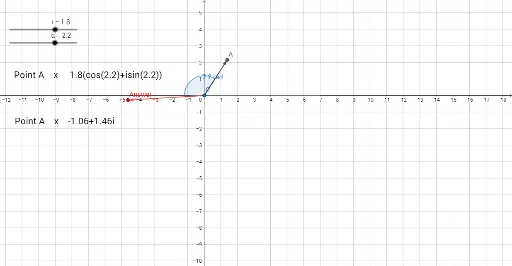
This example demonstrates the geometric interpretation of complex number multiplication on the Argand diagram (complex plane), visually showing how the magnitude and angle transform when multiplying two complex numbers. Core mathematical concepts include the geometric representation of complex numbers, magnitude, angle, trigonometry, and similarity transformation. Construction highlights from the GeoGebra command summary involve the Angle command to calculate angles and objects like a, b, A, r, α, v, c, d, B, w, C, β, e, f, text1, text2 for representing and labeling complex numbers, angles, and transformation results. Suitable for high school and above learners to understand the intuitive geometric meaning of complex operations and deepen the connection between complex numbers and trigonometric functions.
GeoGebra Commands & Parameters
Angle(A, C, B) → β
AI Drawing Prompt Reference
Draw the geometric interpretation of complex number multiplication on the complex plane. First, draw two complex numbers a and b, then represent them by their magnitudes and angles. Next, calculate the product c of a and b, and mark its magnitude and angle. Finally, use angle β to show the rotation of c relative to b, and label all key objects.
The prompt above was compiled from the original drawing commands and is for reference only.