
Multiplication Break Apart with 4 Arrays
Loading the math board and drawing, please wait…
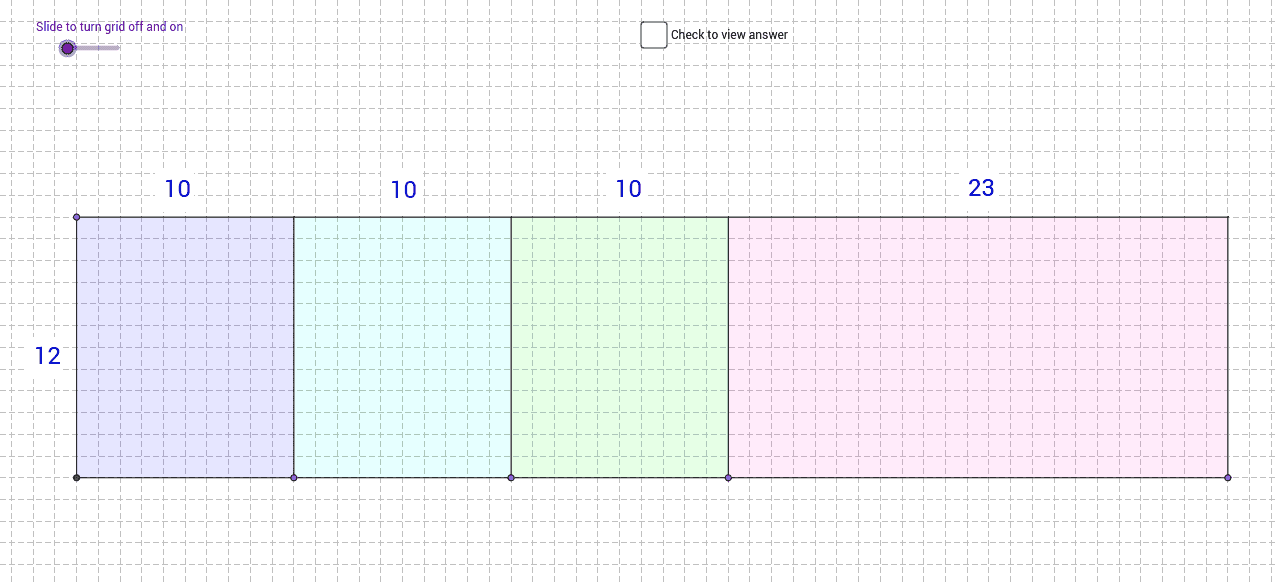
This GeoGebra example demonstrates the break-apart strategy for multiplication using four rectangular arrays, visually representing how a larger multiplication problem can be decomposed into smaller parts. The core mathematical concepts include the distributive property of multiplication, area models, and the connection between addition and multiplication. The construction uses GeoGebra commands such as Polygon to create four arrays, Point, Segment, Line, and Ray for auxiliary elements, and Distance and Area to measure dimensions and areas. The four arrays (poly1 to poly4) are clearly labeled and colored to show the decomposition. This resource is suitable for upper elementary to middle school students learning multiplication strategies, and can be used for classroom demonstrations or independent exploration.
GeoGebra Commands & Parameters
Intersect(xAxis, yAxis) → APoint(xAxis) → BSegment(A, B) → aPoint(yAxis) → CSegment(A, C) → bPoint(b) → DSegment(A, D) → cLine(D, a) → dLine(B, c) → eIntersect(d, e) → ESegment(D, E) → fSegment(E, B) → gPoint(a) → FLine(F, c) → hRay(A, B) → iPoint(i) → GSegment(B, G) → jLine(G, g) → kIntersect(d, h) → HPolygon(H, F, B, E) → poly1, h_1, f_1, b_1, e_1Point(j) → ILine(I, g) → lIntersect(d, l) → JPolygon(B, I, J, E) → poly2, b_2, i_1, j_1, e_2Intersect(d, k) → KPolygon(I, G, K, J) → poly3, i_2, g_1, k_1, j_2Polygon(A, F, H, D) → poly4, a_1, f_2, h_2, d_1Segment(D, A) → mSegment(G, A) → nSegment(G, K) → pSegment(K, D) → qSegment(H, F) → rSegment(E, B) → sSegment(J, I) → tDistance(A, D) → distanceADDistance(D, H) → distanceDHDistance(H, E) → distanceHEDistance(E, J) → distanceEJDistance(J, K) → distanceJKIntersect(m, n) → LIntersect(p, q) → MPolygon(D, L, G, M) → poly5, d_2, l_1, g_2, m_1Area(D, L, G, M) → X
AI Drawing Prompt Reference
Draw a visual representation of the break-apart strategy for multiplication using four rectangular arrays, showing how a larger multiplication problem can be decomposed into smaller parts. The image includes four clearly labeled and colored rectangular arrays, constructed with points and lines, and includes measurements and area displays. Start by plotting the intersection of axes and basic segments, then build the four rectangular arrays, and finally connect them with points and lines to form a complete decomposition model, suitable for classroom demonstrations or student exploration.
The prompt above was compiled from the original drawing commands and is for reference only.