
Mr. Smith's: Area of a Trapezoid
Loading the math board and drawing, please wait…
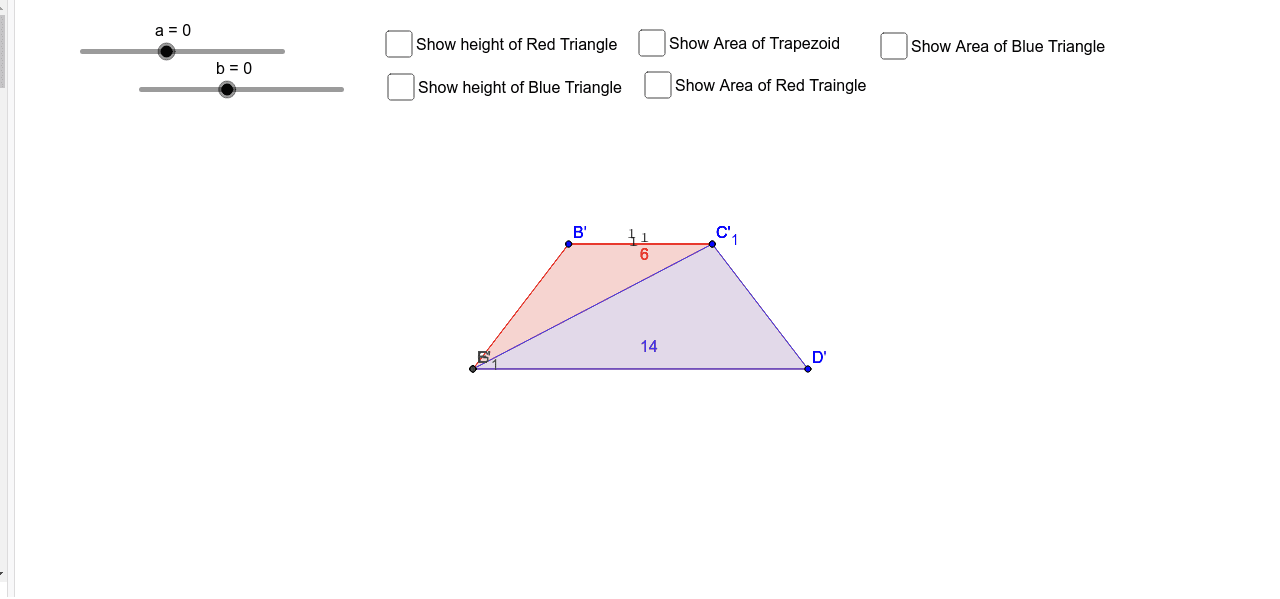
This GeoGebra example dynamically demonstrates the derivation of the area formula for a trapezoid through translation and dissection, converting the trapezoid into a parallelogram or rectangle to visually reveal why area equals half the sum of the bases times the height. Core mathematical concepts include trapezoid properties, area, polygons, vector translation, and geometric transformations. The construction uses commands such as Line, Intersect, Polygon, Vector, Translate, OrthogonalLine, Segment, and PointIn to build the original trapezoid, create auxiliary lines, and translate parts to form a new shape. It is suitable for middle school or high school geometry lessons, serving as an interactive tool for teachers to explain the formula or for students to explore the relationship between shapes. The multiple polygons, segments, and dynamic points allow hands-on manipulation, enhancing understanding of area conservation and geometric reasoning.
GeoGebra Commands & Parameters
Line(A, xAxis) → a_1Intersect(xAxis, yAxis) → EPolygon(E, B, C, D) → poly1, e, b_2, c, dPolygon(E, B, C) → poly2, c_1, e_1, b_1Polygon(E, C, D) → poly3, d_1, e_2, c_2Vector(E, F) → uTranslate(E, u) → E'Translate(B, u) → B'Translate(C, u) → C'Polygon(E', B', C') → poly2', c', e', b'Vector(E, G) → vTranslate(E, v) → E'_1Translate(C, v) → C'_1Translate(D, v) → D'Polygon(E'_1, C'_1, D') → poly3', d', e'_1, c'_1OrthogonalLine(F, a_1) → gIntersect(a_1, g) → HSegment(B', H) → h_1Segment(F, H) → hOrthogonalLine(C'_1, c'_1) → jIntersect(f, j, 1) → ISegment(C'_1, I) → kSegment(I, C'_1) → lSegment(B, H) → iSegment(H, E) → mSegment(B', H) → nSegment(H, F) → pSegment(B', H) → qSegment(H, F) → rSegment(C'_1, I) → sPointIn(poly1) → Pointpoly1PointIn(poly2') → Pointpoly2'PointIn(poly3') → Pointpoly3'_1PointIn(poly3') → Pointpoly3'
AI Drawing Prompt Reference
Draw a trapezoid with its lower base on a horizontal line and its left side vertical. From one vertex, translate a triangular part horizontally to form a parallelogram, and translate another triangular part in a different direction to form another parallelogram, rearranging the trapezoid into a rectangle or parallelogram. Add perpendicular auxiliary lines, mark the translated corresponding points, and place interior points in each polygon to show area relationships. The overall construction demonstrates how a trapezoid can be dissected and translated into an equal-area shape.
The prompt above was compiled from the original drawing commands and is for reference only.