
Motion Detector Simulation
Loading the math board and drawing, please wait…
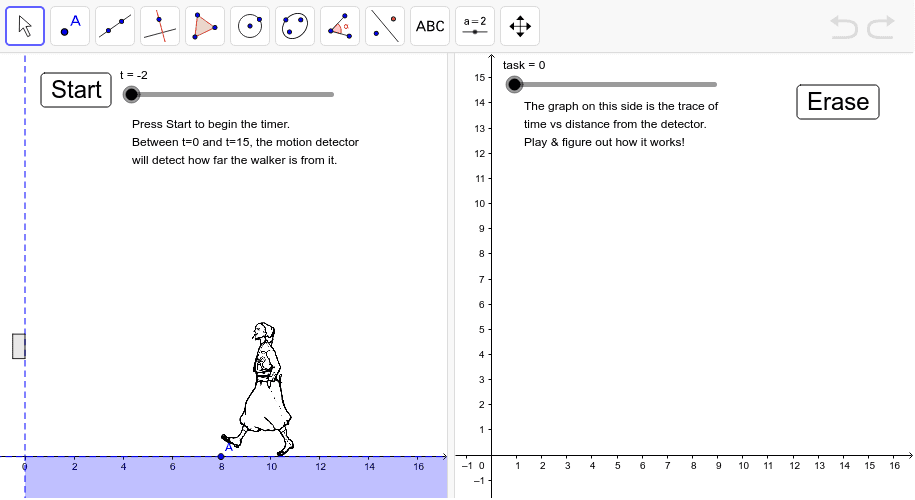
This example demonstrates tracking the trajectory of a walker using a simulated motion detector (like a CBR). Core math concepts include function graphs, geometric mean, fractal geometry, interest calculation, and exponentiation. Construction highlights the use of GeoGebra commands/objects like Point, LineBisector, Mirror, Polygon, and Sequence. Suitable for high school students learning functions, geometric transformations, and data analysis, useful for mathematical modeling of physical experiments.
GeoGebra Commands & Parameters
Point(Ray[(0, 0), (1, 0)]) → ALineBisector(A, B) → aMirror(pic1, a) → pic1'Polygon((0, 4), (0, 5), (-0.5, 5), (-0.5, 4)) → poly1, b, c, d, eSequence(CircleArc[(i, 4.5), (i + 0.2, 4), (i + 0.2, 5)], i, 1, floor(x(A))) → list1
AI Drawing Prompt Reference
Draw a simulation of a motion detector tracking a walker's trajectory, including a point moving along the x-axis, a perpendicular bisector through the point, and a mirrored reflection of a rectangle across the bisector, with a series of arcs above the rectangle showing geometric transformations and functional relationships.
The prompt above was compiled from the original drawing commands and is for reference only.