
Morley's Triangle Theorem: Dynamic Proof and Construction
Loading the math board and drawing, please wait…
In collections
Besondere Punkte/Special Points
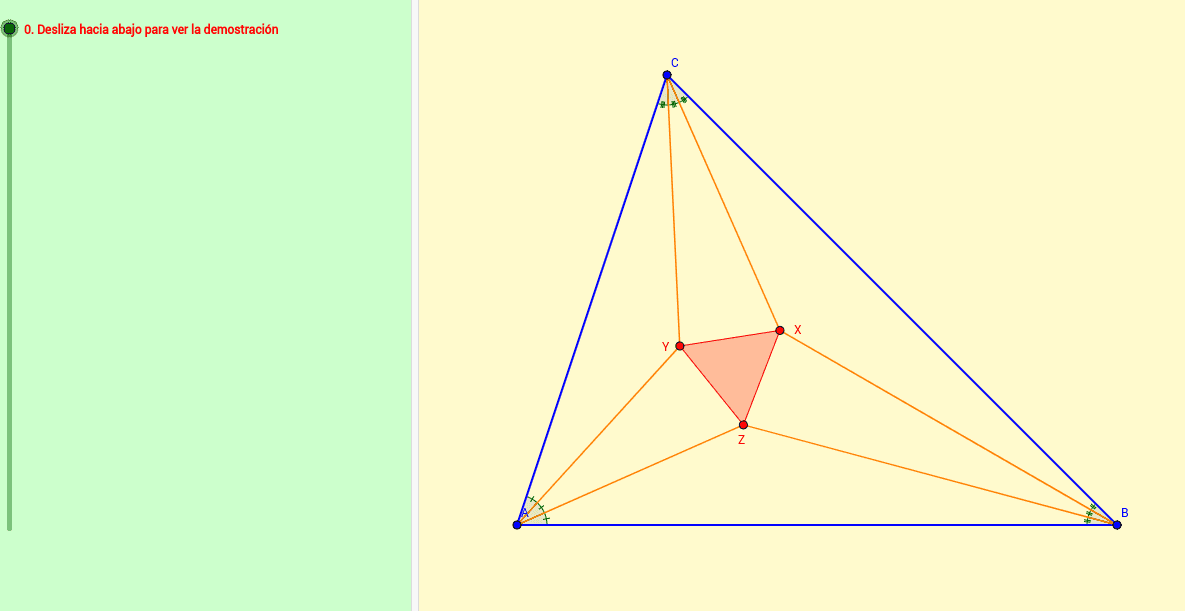
This GeoGebra example dynamically demonstrates Morley's Theorem: for any triangle, the intersections of adjacent angle trisectors form an equilateral triangle. The core mathematical concepts include angle trisection, equilateral triangle properties, triangle angle sum, and intersection points of lines. The construction uses commands such as Polygon to create the original triangle ABC, Angle and Rotate to trisect each interior angle, Ray and Intersect to locate the trisector intersection points, Circle and Segment to construct and verify the equilateral triangle, and Center to mark its center. Suitable for high school and university students and teachers, this example serves as an interactive exploration of a classical geometry theorem, a demonstration of dynamic geometric construction techniques, and a valuable resource for math competitions or advanced geometry courses.
GeoGebra Commands & Parameters
Polygon(A, B, C) → polígono1, c, a, bAngle(polígono1) → α_3, β_3, γ_3Rotate(B, α_3 / 3, A) → B'Rotate(B, (2 * α_3 / 3), A) → B'_1Rotate(C, β_3 / 3, B) → C'Rotate(C, (2 * β_3 / 3), B) → C'_1Rotate(A, γ_3 / 3, C) → A'Rotate(A, (2 * γ_3 / 3), C) → A'_1Ray(A, B') → fRay(A, B'_1) → gRay(B, C') → hRay(B, C'_1) → iRay(C, A') → jRay(C, A'_1) → kIntersect(f, i) → ZIntersect(h, k) → XIntersect(g, j) → YPolygon(Y, Z, X) → polígono2, e, f_1, dAngle(B, A, Z) → αAngle(Z, A, Y) → α_1Angle(Y, A, C) → α_2Angle(C, B, C') → βAngle(C', B, C'_1) → β_1Angle(C'_1, B, A) → β_2Angle(A, C, A') → γAngle(A', C, A'_1) → γ_1Angle(A'_1, C, B) → γ_2Intersect(g, h) → UCircle(Y, X, C) → wIntersect(w, b, 2) → X'Intersect(w, a, 2) → Y'Segment(U, Z) → lAngle(X, Z, U) → δAngle(U, Z, Y) → εSegment(A, Z) → mSegment(A, U) → nSegment(B, U) → qSegment(B, Z) → rSegment(C, Y) → sSegment(C, X) → tSegment(A, Y) → g_1Segment(B, X) → h_1Angle(X, Z, Y) → ζSegment(Y, X') → i_1Segment(X, Y') → j_1Angle(Y', X, Y) → ηAngle(X, Y, X') → θCenter(w) → OSegment(X', O) → k_1Segment(O, Y) → l_1Segment(O, X) → m_1Segment(O, Y') → n_1Angle(X', O, Y) → ιAngle(Y, O, X) → κAngle(X, O, Y') → λSegment(X', Y') → p
AI Drawing Prompt Reference
Draw an arbitrary triangle with three vertices. Trisect each interior angle, and from each vertex draw two rays that divide the angle into three equal parts. The adjacent trisectors from neighboring vertices intersect at three points, which form an equilateral triangle; connect these three points with solid lines. Also draw the original triangle's sides, and auxiliary segments from each original vertex to the corresponding new triangle vertex. Finally, draw the circumcircle of the equilateral triangle and mark its center.
The prompt above was compiled from the original drawing commands and is for reference only.