
Modular Arithmetic
Loading the math board and drawing, please wait…
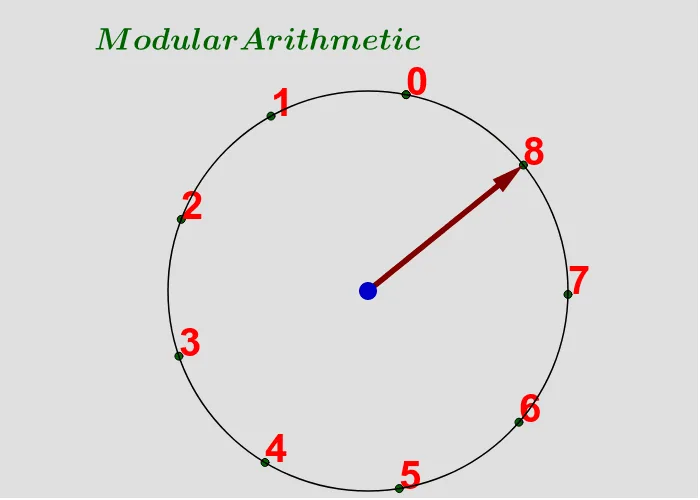
This example demonstrates the basic concepts of modular arithmetic and its applications in geometry. Modular arithmetic is a special form of division where the result is the remainder. Using GeoGebra commands such as Circle, Point, Segment, Sequence, and Mod, the properties of modular arithmetic are visually illustrated. Suitable for students from middle school and above.
GeoGebra Commands & Parameters
Circle(A, 4) → cPoint(c) → BSegment(A, B) → fSequence(Rotate[B, i°, A], i, 0, 360, 360 / Mod) → list_1Sequence(i, i, 0, Mod - 1, 1) → moduloElement(modulo, Mod) → PSequence(Text["" + (modulo(k)) + "", list_1(k), true], k, 1, Mod) → list_2Mod(Num, Mod) → aTextfield(Mod) → InputBox1Textfield(Num) → InputBox2Rotate(A, ((360°) / Mod * a), A) → A'Vector(A, B) → uRotate(u, ((360°) / Mod * a), A) → u'
AI Drawing Prompt Reference
Draw a circle and a line segment from its center to a point on the circle. Rotate the line segment at regular angles around the center to form a sequence of rays, illustrating the periodicity of modular arithmetic. Label the endpoints of the rays with corresponding modular values. Allow the user to input a number, rotate the center based on the modular result, and display the direction of the rotated ray.
The prompt above was compiled from the original drawing commands and is for reference only.