
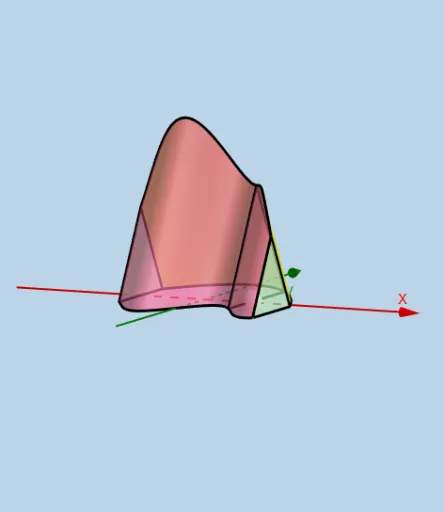
Modifiable Solid with Equilateral Triangular Cross Sections
Loading the math board and drawing, please wait…
This example demonstrates constructing a solid where the cross sections parallel to the y-axis are equilateral triangles, with side lengths equal to the difference between the upper and lower functions. Key mathematical concepts include equilateral triangles, functions, and integrals. GeoGebra commands used include Segment, Midpoint, Intersect, Line, Polygon, Textfield, CurveCartesian, Surface, and Integral. Suitable for high school and above students learning solid geometry and calculus.
GeoGebra Commands & Parameters
Segment(H, I) → s_1Midpoint(s_1) → ESegment(J, K) → q_1Midpoint(q_1) → FIntersect(upper, h, (4.29, 7.239385)) → BIntersect(lower, h, (4.29, -4.3871887808018935)) → CSegment(C, B) → qIntersect(upper, q, (4.29, 7.239385)) → GMidpoint(C, G) → TLine(B, D) → iSegment(C, B) → pPolygon(C, G, U) → q1, f_1, g_1, n_1Polygon(K, J, W) → q2, l, m, nPolygon(Q, P, V) → q3, r, s, tTextfield(upper) → InputBox1Textfield(lower) → InputBox2Textfield(a) → InputBox3Textfield(b) → InputBox4Segment(K, W) → fSegment(W, J) → gSegment(Q, V) → jSegment(V, P) → kCurveCartesian(t, (0.5 * (upper(t) + lower(t))), ((sqrt(3) * 1 / 2) * (upper(t) - lower(t))), t, a, b) → cSurface(u, ((1 - v) * lower(u)) + ((0.5 * v) * (lower(u) + upper(u))), (sqrt(3) / 2 * (v * (upper(u) - lower(u)))), u, a, b, v, 0, 1) → oSurface(u, (v * upper(u)) + (((1 - v) * 0.5) * (lower(u) + upper(u))), (((sqrt(3) * 0.5) * (1 - v)) * (upper(u) - lower(u))), u, a, b, v, 0, 1) → uSegment(C, U) → i_1Segment(U, G) → j_1Segment(C, G) → k_1Integral((t_1(x) * t_1(x)), a, b) → a_1Integral((t_1(x) - h_1(x))^(2), a, b) → w
AI Drawing Prompt Reference
Create a solid where the cross sections parallel to the y-axis are equilateral triangles, with side lengths equal to the difference between the upper and lower functions. First, define the upper and lower functions, then construct equilateral triangular cross sections within the specified interval, and finally connect these cross sections to form the solid.
The prompt above was compiled from the original drawing commands and is for reference only.