
Mixed Tasks - Deltoid
Loading the math board and drawing, please wait…
In collections
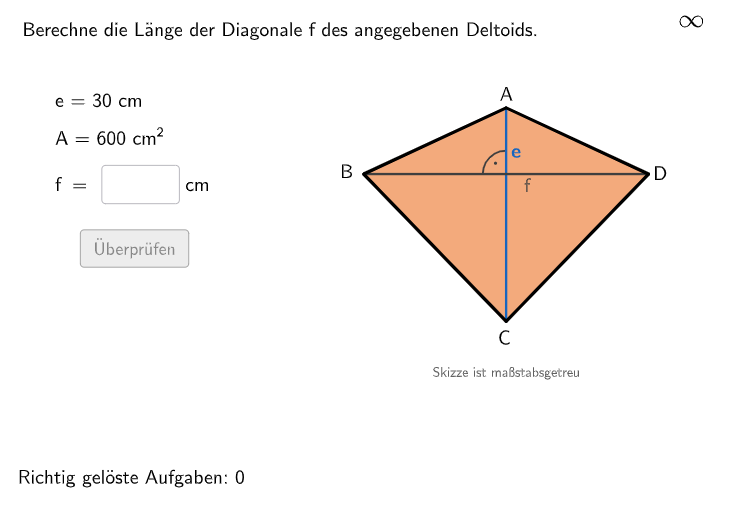
Deltoid - Flächeninhalt und Umkehraufgaben
This example demonstrates the construction and properties of a deltoid. Key math concepts include polygons, angle calculations, and formula manipulation. GeoGebra commands and objects used in the construction are Join, Sequence, Element, Zip, If, Segment, Textfield, Polygon, Append, Remove, Intersect, Angle, NumberSeparationComma, Text. Suitable for 7-8 grade students to practice solving inverse problems related to quadrilaterals.
GeoGebra Commands & Parameters
Join({Sequence[1, 15], {20, 30, 40, 50}}) → listPoolSequence(RandomElement[listPool], m, 1, 110) → randomNosForX, {1, 30, 11, 11, 8, 15, 20, 7, 14, 4, 30, 7, 3, 5, 3, 6, 13, 11, 9, 1, 50, 1, 30, 9, 5, 1, 8, 10, 11, 9, 30, 14, 8, 11, 8, 14, 15, 1, 13, 3, 14, 15, 13, 50, 12, 1, 40, 30, 2, 40, 50, 14, 10, 6, 7, 4, 4, 15, 12, 2, 30, 12, 6, 1, 15, 7, 1, 30, 8, 8, 40, 14, 6, 10, 11, 8, 6, 8, 1, 1, 7, 11, 10, 12, 50, 15, 11, 40, 2, 1, 15, 9, 8, 40, 15, 9, 12, 40, 2, 40, 20, 11, 8, 7, 14, 50, 5, 14, 10, 5}Element(randomNosForX, Mod[questionCount, 100] + 1) → numXZip(RandomElement[listPool \ Join[{{m}, Sequence[1, (floor(m) * (1 - percentage))], Sequence[(ceil(m) * (1 + percentage)), 50]}]], m, randomNosForX) → randomNosForYIf(Defined[numYrandom], numYrandom, floor((numX * 1.5))) → numYIf(numX ≥ numY, P1, P5) → AIf(numX ≥ numY, P3, P7) → CSegment(A, C) → e1Sequence(RandomElement[Sequence[0.3, 0.5, 0.01]], m, 1, 110) → randomNosForProp, {0.38000000000000006, 0.31, 0.32, 0.32, 0.3, 0.35000000000000003, 0.47000000000000014, 0.48000000000000015, 0.31, 0.5000000000000001, 0.39000000000000007, 0.35000000000000003, 0.4100000000000001, 0.47000000000000014, 0.37000000000000005, 0.48000000000000015, 0.3, 0.35000000000000003, 0.3, 0.47000000000000014, 0.47000000000000014, 0.4500000000000001, 0.38000000000000006, 0.34, 0.33, 0.38000000000000006, 0.48000000000000015, 0.36000000000000004, 0.46000000000000013, 0.3, 0.4300000000000001, 0.4300000000000001, 0.46000000000000013, 0.4200000000000001, 0.32, 0.36000000000000004, 0.34, 0.36000000000000004, 0.3, 0.37000000000000005, 0.31, 0.32, 0.46000000000000013, 0.4100000000000001, 0.34, 0.34, 0.37000000000000005, 0.4200000000000001, 0.4100000000000001, 0.38000000000000006, 0.46000000000000013, 0.3, 0.4400000000000001, 0.4500000000000001, 0.4100000000000001, 0.4400000000000001, 0.38000000000000006, 0.33, 0.4000000000000001, 0.46000000000000013, 0.4400000000000001, 0.3, 0.46000000000000013, 0.4500000000000001, 0.38000000000000006, 0.4300000000000001, 0.5000000000000001, 0.4100000000000001, 0.31, 0.37000000000000005, 0.4000000000000001, 0.48000000000000015, 0.47000000000000014, 0.31, 0.4500000000000001, 0.35000000000000003, 0.4200000000000001, 0.36000000000000004, 0.36000000000000004, 0.49000000000000016, 0.4500000000000001, 0.4400000000000001, 0.39000000000000007, 0.47000000000000014, 0.4500000000000001, 0.4100000000000001, 0.5000000000000001, 0.36000000000000004, 0.47000000000000014, 0.47000000000000014, 0.48000000000000015, 0.49000000000000016, 0.35000000000000003, 0.32, 0.3, 0.49000000000000016, 0.33, 0.5000000000000001, 0.4100000000000001, 0.3, 0.34, 0.32, 0.4000000000000001, 0.48000000000000015, 0.37000000000000005, 0.35000000000000003, 0.36000000000000004, 0.4100000000000001, 0.4400000000000001, 0.49000000000000016}If(numX ≥ numY, P4, P8) → DIf(numX ≥ numY, P2, P6) → BSegment(B, D) → f1Join(Sequence[Shuffle[{1, 2, 3}], k, 1, 34]) → CaseListIf(Case ≟ 1, numX, Case ≟ 2, numY, numZ) → solTextfield(input1) → InputBox1Textfield(input2) → InputBox2Polygon(PtopLeftCornerFeedback, PtopRightCornerFeedback, PbottomRightCornerFeedback, PbottomLeftCornerFeedback) → rectangleCorrect, rectangleCorrectS3, rectangleCorrectS4, rectangleCorrectS2, rectangleCorrectS1Append(true, Sequence[If[randomNosForX(i) ≟ randomNosForX(i - 1), false, true], i, 2, 100]) → stayXAppend(true, Sequence[If[randomNosForY(i) ≟ randomNosForY(i - 1), false, true], i, 2, 100]) → stayYRemove(Sequence[If[stayX(i), randomNosForX(i), 0], i, 1, 100], Sequence[0, i, 1, 100]) → randomNosForXwithoutRepeatRemove(Sequence[If[stayY(i), randomNosForY(i), 0], i, 1, 100], Sequence[0, i, 1, 100]) → randomNosForYwithoutRepeatElement(randomNosForXwithoutRepeat, Mod[questionCount, Length[randomNosForXwithoutRepeat]] + 1) → numXwithoutRepeatElement(randomNosForYwithoutRepeat, Mod[questionCount, Length[randomNosForYwithoutRepeat]] + 1) → numYwithoutRepeatIntersect(e1, f1) → EAngle(A, E, D) → αNumberSeparationComma((numX * numY)) → numberSeparationZaehlerText("\scriptsize{\textsf{Skizze ist maßstabsgetreu}}", C + (0, -0.6), false, true, 0, -1) → txtSkizze
AI Drawing Prompt Reference
Draw a deltoid by first creating two line segments e1 and f1, connecting points A and C, and B and D respectively. The coordinates of A, B, C, and D are generated randomly to satisfy the deltoid's properties. Then, find the intersection point E of e1 and f1, and calculate angle α. Finally, create a rectangle based on given x and y values, ensuring the rectangle matches the size of the deltoid.
The prompt above was compiled from the original drawing commands and is for reference only.