
Missing Angle in a Triangle
Loading the math board and drawing, please wait…
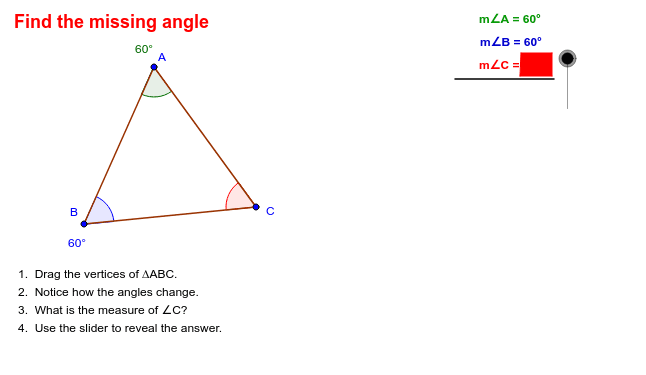
This GeoGebra example demonstrates how to find the missing angle in a triangle when other angles or sides are known. The core mathematical concepts involve the triangle angle sum theorem, which states that the sum of interior angles is 180 degrees, and basic angle calculation techniques. Key construction elements include the Polygon command to draw the triangle, Angle command to label and measure angles, Segment command to define sides, and Translate command for shifting objects to illustrate relationships. Objects such as points A, B, C, P, segments a, b, c, angles α, β, γ, and text labels like T1, T2 are used for dynamic visualization. It is suitable for middle school or high school geometry education, aiding in teaching angle properties and problem-solving skills.
GeoGebra Commands & Parameters
Polygon(A, B, C) → P, c, a, bAngle(P) → α, β, γSegment(D, E) → dPolygon(F, G, H, I) → Q, f, g, h, iTranslate(F, z) → F'Translate(G, z) → G'Translate(H, z) → H'Translate(I, z) → I'Polygon(F', G', H', I') → Q', j, k, l, m
AI Drawing Prompt Reference
Draw a triangle with labeled and measured interior angles, demonstrating that their sum is 180 degrees. Also, draw an auxiliary quadrilateral, translate it along a direction, and then draw the translated quadrilateral to observe the relationship between the original and translated shapes.
The prompt above was compiled from the original drawing commands and is for reference only.