
Midpoints of an Isosceles Trapezoid Form a Rhombus
Loading the math board and drawing, please wait…
In collections
Expressing Geometric Properties with Equations (GPE) Cluster
Unit 7: Polygons and Quadrilaterals
Quadrilaterals
Coordinate Geometry Proof Prompts
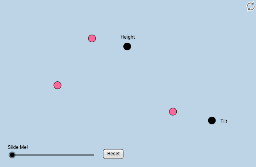
This example demonstrates that the midpoints of the sides of an isosceles trapezoid form a rhombus. It involves core concepts such as properties of isosceles trapezoids, midpoint quadrilaterals, rhombus criteria, and coordinate geometry. The construction uses commands like Line, Ray, Point, Midpoint, Slope, OrthogonalLine, Mirror, Dilate, Segment, Circle, Intersect, Vector, Translate, Angle, Rotate, and Polygon. It is suitable for high school students and geometry enthusiasts to learn and verify geometric theorems.
GeoGebra Commands & Parameters
Line(A, B) → aRay(A, B) → bPoint(b) → CMidpoint(A, C) → DLine(A, C) → cSlope(c) → dOrthogonalLine(D, c) → gPoint(g) → ERay(D, E) → hPoint(h) → FSlope(h) → iLine(F, c) → lPoint(l) → GPoint(l) → HRay(F, G) → mRay(F, H) → nPoint(m) → IMirror(I, h) → I'Dilate(A, If[0 < o ≤ 1, 1 - o, 0], C) → A'Segment(A, A') → pDilate(A, If[1 < o ≤ 2, 2 - o, 0], I) → A'_1Segment(A, A'_1) → qSegment(A, C) → rSegment(C, I') → sSegment(I', I) → tSegment(I, A) → a_1Circle(A, (0.2 * Min[a_1, r])) → c_1Circle(I, (0.2 * Min[a_1, r])) → d_1Intersect(d_1, a_1, 1) → JIntersect(d_1, t, 1) → KIntersect(c_1, r, 1) → LIntersect(c_1, a_1, 1) → MDilate(I, If[2 < o ≤ 3, 3 - o, 0], I') → I'_1Segment(I, I'_1) → b_1Dilate(A, If[3 < o ≤ 4, 4 - o, 0], C) → A'_2Vector(A, A'_2) → uTranslate(A, u) → A'_3Translate(A'_1, u) → NSegment(A'_3, N) → q'OrthogonalLine(A, r) → g_1Point(g_1) → OAngle(I, A, O) → αAngle(I', C, A) → βRotate(A'_3, If[4 < o ≤ 5, (((o - 4) * 2) * α), (2 * α)], C) → PRotate(N, If[4 < o ≤ 5, (((o - 4) * 2) * α), (2 * α)], C) → N'Segment(P, N') → q''Dilate(A, If[5 < o ≤ 6, 6 - o, 0], C) → A'_4Vector(A, A'_4) → vDilate(I, If[7 < o ≤ 8, 8 - o, 0], I') → I'_2Vector(I, I'_2) → wDilate(A, If[5 < o ≤ 6, 6 - o, 0], I') → A'_5Dilate(A, If[6 < o ≤ 7, 7 - o, 0], I) → A'_6Vector(A, A'_6) → u_1Translate(A, u_1) → A'_7Translate(A'_5, u_1) → QSegment(I, C) → l_1Angle(L, A, I') → γRotate(A'_7, If[11 < o ≤ 12, ((-(o - 11)) * (2 * γ)), (-2 * γ)], I) → RRotate(Q, If[7 < o ≤ 8, (((-(o - 7)) * 2) * γ), (-2 * γ)], I) → Q'Polygon(A, C, I', I) → poly1, a_2, c_2, i', i_2Midpoint(a_1) → SMidpoint(t) → TMidpoint(s) → UMidpoint(r) → VDilate(A, If[5.5 < o ≤ 6.5, 6.5 - o, 0], S) → A'_8Dilate(I, If[5.5 < o ≤ 6.5, 6.5 - o, 0], T) → I'_3Dilate(I', If[5.5 < o ≤ 6.5, 6.5 - o, 0], U) → I''Dilate(C, If[5.5 < o ≤ 6.5, 6.5 - o, 0], V) → C'Segment(A, A'_8) → f_1Segment(I, I'_3) → h_1Segment(I', I'') → i_1Segment(C, C') → j_1Rotate(A, If[6.5 < o ≤ 7.5, ((-(o - 6.5)) * π), (-π)], S) → A'_9Rotate(A'_8, If[6.5 < o ≤ 7.5, ((-(o - 6.5)) * π), (-π)], S) → WSegment(A'_9, W) → k_1Rotate(I, If[6.5 < o ≤ 7.5, ((-(o - 6.5)) * π), (-π)], T) → I'_4Rotate(I'_3, If[6.5 < o ≤ 7.5, ((-(o - 6.5)) * π), (-π)], T) → ZSegment(I'_4, Z) → m_1Rotate(I', If[6.5 < o ≤ 7.5, ((-(o - 6.5)) * π), (-π)], U) → I''_1Rotate(I'', If[6.5 < o ≤ 7.5, ((-(o - 6.5)) * π), (-π)], U) → I'''Segment(I''_1, I''') → n_1Rotate(C, If[6.5 < o ≤ 7.5, ((-(o - 6.5)) * π), (-π)], V) → C'_1Rotate(C', If[6.5 < o ≤ 7.5, ((-(o - 6.5)) * π), (-π)], V) → C''Segment(C'_1, C'') → p_1Dilate(V, If[7.5 < o ≤ 8.5, 8.5 - o, 0], S) → V'Segment(V, V') → q_1Angle(V, S, T) → δRotate(V, If[8.5 < o ≤ 9.5, ((o - 8.5) * δ), δ], S) → V'_1Rotate(V', If[8.5 < o ≤ 9.5, ((o - 8.5) * δ), δ], S) → V''Segment(V'_1, V'') → r_1Rotate(V'_1, If[9.5 < o ≤ 10.5, ((o - 9.5) * (π - δ)), π - δ], T) → A_1Rotate(V'', If[9.5 < o ≤ 10.5, ((o - 9.5) * (π - δ)), π - δ], T) → V'''Segment(A_1, V''') → s_1Rotate(A_1, If[10.5 < o ≤ 11.5, ((o - 10.5) * δ), δ], U) → B_1Rotate(V''', If[10.5 < o ≤ 11.5, ((o - 10.5) * δ), δ], U) → C_1Segment(B_1, C_1) → t_1Polygon(A, V, S) → poly2, s_2, a_3, v_1Polygon(S, I, T) → poly3, t_2, s_3, i_3Polygon(T, U, I') → poly4, i'_1, t_3, u_2Polygon(V, C, U) → poly5, u_3, v_2, c_3Polygon(V, U, T, S) → poly6, v_3, u_4, t_4, s_4
AI Drawing Prompt Reference
Draw an isosceles trapezoid, then find the midpoints of its sides and connect these midpoints to form a new quadrilateral. Verify that this quadrilateral is a rhombus. First, draw the two bases of the isosceles trapezoid, then find the midpoints of the bases, draw lines through these midpoints, find the perpendicular lines to these lines, determine the new vertices, and connect these vertices to form a rhombus.
The prompt above was compiled from the original drawing commands and is for reference only.