
Merry Christmas: A Festive Geometric Puzzle of Symmetry and Conics
Loading the math board and drawing, please wait…
In collections
STEAM like Leonardo
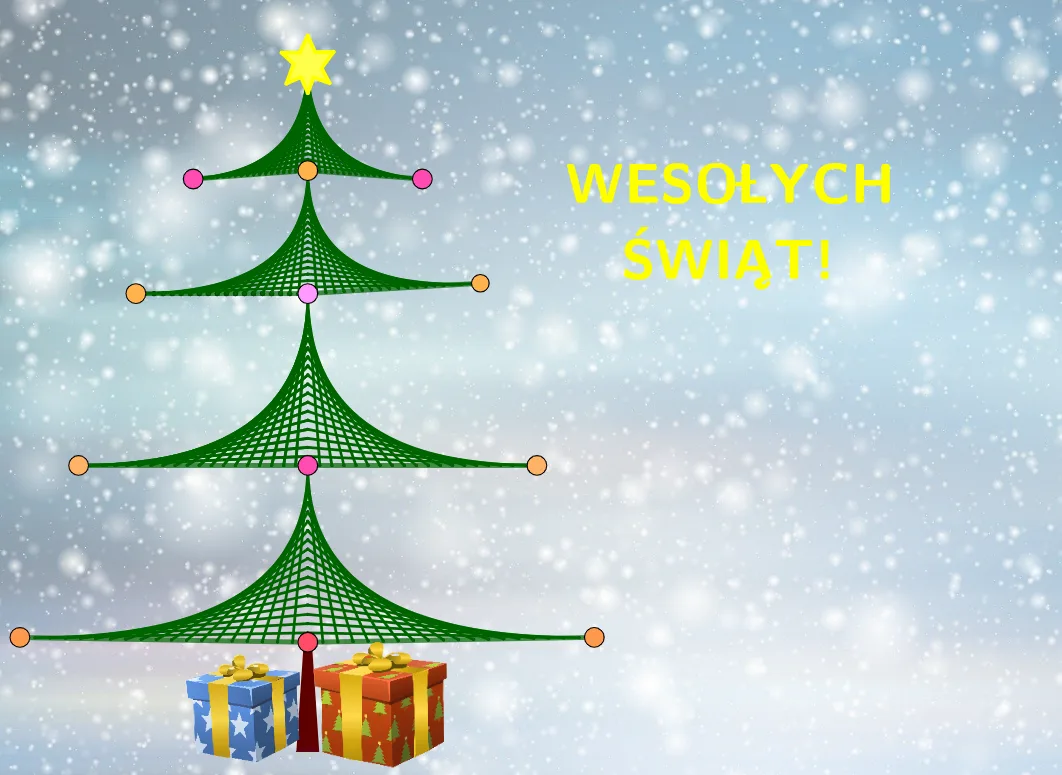
① This example, titled 'Merry Christmas', demonstrates a festive geometric composition built through symmetry and conic sections, showing how mathematics can create holiday-themed art. ② Core mathematical concepts include symmetry (Symetria), conic sections, geometric transformations, and touches of calculus and algebra, using basic elements like points, segments, circles, and polygons. ③ Construction details: From the summary, GeoGebra commands such as Point, Segment, Sequence, Circle, Intersect, and Polygon are used, creating objects A, B, f, C, D, g, E, h, F, G, i, H, j, I, J, k, K, l, L, M, m, N, n₁, n, and l1–l16. Sequences generate symmetric patterns, while intersections of circles and polygons build decorative structures. ④ This is suitable for middle school and above, ideal for holiday activities exploring geometric transformations and conic properties, or as a creative resource for teachers designing interdisciplinary lessons to spark student interest.
GeoGebra Commands & Parameters
Point(xAxis) → BSegment(A, B) → fPoint(f) → DSegment(C, D) → gSegment(D, E) → hPoint(f) → GSegment(F, G) → iSegment(G, H) → jPoint(f) → JSegment(I, J) → kSegment(J, K) → lPoint(f) → MSegment(L, M) → mSegment(M, N) → n_{1}Sequence(A + (i / n * (M - A)), i, 1, n) → l1Sequence(L + (i / n * (M - L)), i, 1, n) → l2Sequence(Segment[Element[l1, i], Element[l2, n - i]], i, 1, n) → l3Sequence(N + (i / n * (M - N)), i, 1, n) → l4Sequence(C + (i / n * (D - C)), i, 1, n) → l5Sequence(M + (i / n * (D - M)), i, 1, n) → l6Sequence(E + (i / n * (D - E)), i, 1, n) → l7Sequence(D + (i / n * (G - D)), i, 1, n) → l8Sequence(F + (i / n * (G - F)), i, 1, n) → l9Sequence(H + (i / n * (G - H)), i, 1, n) → l10Sequence(G + (i / n * (J - G)), i, 1, n) → l11Sequence(I + (i / n * (J - I)), i, 1, n) → l12Sequence(K + (i / n * (J - K)), i, 1, n) → l13Sequence(Segment[Element[l4, i], Element[l1, n - i]], i, 1, n) → l14Sequence(Segment[Element[l5, i], Element[l6, n - i]], i, 1, n) → l15Sequence(Segment[Element[l6, i], Element[l7, n - i]], i, 1, n) → l16Sequence(Segment[Element[l9, i], Element[l8, n - i]], i, 1, n) → l17Sequence(Segment[Element[l8, i], Element[l9, n - i]], i, 1, n) → l18Sequence(Segment[Element[l8, i], Element[l10, n - i]], i, 1, n) → l19Sequence(Segment[Element[l11, i], Element[l12, n - i]], i, 1, n) → l20Sequence(Segment[Element[l11, i], Element[l13, n - i]], i, 1, n) → l21Circle(A, 0.25) → cCircle(A, 0.5) → dPoint(d) → OPoint(c) → PPoint(d) → QPoint(c) → RPoint(d) → SPoint(c) → TPoint(d) → UPoint(c) → VIntersect(d, f, 1) → WPoint(c) → ZPoint(d) → A_1Point(c) → B_1Polygon(O, P, A_1, B_1, Q, R, S, T, U, V, W, Z) → wielokąt1, o, z_1, a_1, b_1, p, q, r, s, t, u, v, wPoint(k) → C_1Point(l) → D_1Polygon(C_1, E_1, F_1, D_1) → q1, c_1, e_1, f_1, d_1
AI Drawing Prompt Reference
Draw a festive symmetric geometric pattern featuring multiple intersecting circles and lines, with a small circle at the center and two larger circles. Small dots are distributed on the larger circles. Extend symmetric lines from the center point, connecting intersections with the larger circles and their own circles, creating a complex decorative structure. The design showcases rotational and central symmetry, ideal for a holiday-themed art piece.
The prompt above was compiled from the original drawing commands and is for reference only.