
Medians and Centroid Illustrated: A Proof Without Words
Loading the math board and drawing, please wait…
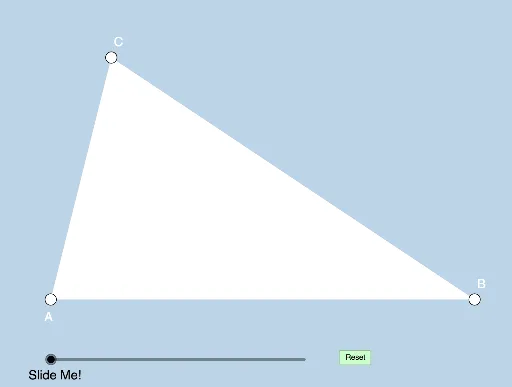
① This GeoGebra example visually demonstrates that the three medians of a triangle intersect at the centroid, and that the centroid divides each median in a 2:1 ratio, presented as a 'proof without words'. ② Core mathematical concepts include triangle medians, the centroid (barycenter), the 2:1 division ratio of medians, and geometric relationships involving areas or segment lengths. ③ Construction highlights: using GeoGebra commands such as Midpoint to find side midpoints, Segment to draw medians, Intersect to locate the centroid, Dilate to scale segments and verify the 2:1 ratio, Rotate and Polygon to create auxiliary shapes (e.g., trapezoids or rotated triangles) that reinforce the proof. The object list includes multiple midpoints, intersection points, and rotated copies (A', A'', etc.), enabling dynamic manipulation and verification. ④ This is ideal for middle or high school geometry classes when teaching centroid properties, and serves as an interactive resource for teachers or students to explore the theorem's visual foundation.
GeoGebra Commands & Parameters
Midpoint(A, B) → DMidpoint(B, C) → EMidpoint(C, A) → FSegment(A, B) → aSegment(B, C) → bSegment(C, A) → cSegment(C, D) → dSegment(A, E) → eSegment(B, F) → fIntersect(d, e) → GDilate(A, If[0 < g ≤ 1, 1 - g, 0], D) → A'Segment(A, A') → hRotate(A, If[1 < g ≤ 2, ((-(g - 1)) * π), (-π)], D) → A'_1Rotate(A', If[1 < g ≤ 2, ((g - 1) * π), 3.141592653589793], D) → A''Segment(A'_1, A'') → h'Dilate(B, If[2 < g ≤ 3, 3 - g, 0], E) → B'Segment(B, B') → iRotate(B, If[3 < g ≤ 4, ((-(g - 3)) * π), (-π)], E) → B'_1Rotate(B', If[3 < g ≤ 4, ((g - 3) * π), 3.141592653589793], E) → B''Segment(B'_1, B'') → i'Dilate(C, If[4 < g ≤ 5, 5 - g, 0], F) → C'Segment(C, C') → jRotate(C, If[5 < g ≤ 6, ((-(g - 5)) * π), (-π)], F) → C'_1Rotate(C', If[5 < g ≤ 6, ((g - 5) * π), 3.141592653589793], F) → C''Segment(C'_1, C'') → j'Midpoint(G, C) → HMidpoint(G, B) → IMidpoint(A, G) → JDilate(C, If[6 < g ≤ 7, 7 - g, 0], H) → C'_2Segment(C, C'_2) → kDilate(H, If[7 < g ≤ 8, 8 - g, 0], G) → H'Segment(H, H') → lDilate(G, If[8 < g ≤ 9, 9 - g, 0], D) → G'Segment(G, G') → mDilate(A, If[9 < g ≤ 10, 10 - g, 0], J) → A'_2Segment(A, A'_2) → nDilate(J, If[10 < g ≤ 11, 11 - g, 0], G) → J'Segment(J, J') → pDilate(G, If[11 < g ≤ 12, 12 - g, 0], E) → G'_1Segment(G, G'_1) → qPolygon(A, B, C) → poly1, c_1, a_1, b_1Dilate(F, If[12 < g ≤ 13, 13 - g, 0], G) → F'Segment(F, F') → rRotate(F, If[14 < g ≤ 15, ((g - 14) * π), 3.141592653589793], G) → F'_1Rotate(F', If[14 < g ≤ 15, ((g - 14) * π), 3.141592653589793], G) → F''Segment(F'_1, F'') → r'Rotate(F'_1, If[15 < g ≤ 16, ((g - 15) * π), 3.141592653589793], I) → KRotate(F'', If[15 < g ≤ 16, ((g - 15) * π), 3.141592653589793], I) → F'''Segment(K, F''') → r''Rotate(G, If[16 < g ≤ 17, ((g - 16) * π), 3.141592653589793], G) → G'_2Rotate(G'_1, If[16 < g ≤ 17, ((g - 16) * π), 3.141592653589793], G) → LSegment(G'_2, L) → q'Rotate(G'_2, If[17 < g ≤ 18, ((g - 17) * π), 3.141592653589793], J) → MRotate(L, If[17 < g ≤ 18, ((g - 17) * π), 3.141592653589793], J) → L'Segment(M, L') → q''Rotate(G, If[18 < g ≤ 19, ((g - 18) * π), 3.141592653589793], G) → G'_3Rotate(G', If[18 < g ≤ 19, ((g - 18) * π), 3.141592653589793], G) → G''Segment(G'_3, G'') → m'Rotate(G'_3, If[19 < g ≤ 20, ((g - 19) * π), 3.141592653589793], H) → NRotate(G'', If[19 < g ≤ 20, ((g - 19) * π), 3.141592653589793], H) → G'''Segment(N, G''') → m''
AI Drawing Prompt Reference
Draw a triangle with its three medians intersecting at the centroid. Show that the centroid divides each median in a 2:1 ratio. Include auxiliary segments and rotated or scaled copies of parts of the triangle around the centroid or midpoints, to visually demonstrate the equal-area or length relationships. The figure should contain the original triangle, the medians, the centroid, side midpoints, and several rotated or dilated copies of vertices or segments, all arranged to illustrate the centroid's properties dynamically.
The prompt above was compiled from the original drawing commands and is for reference only.