
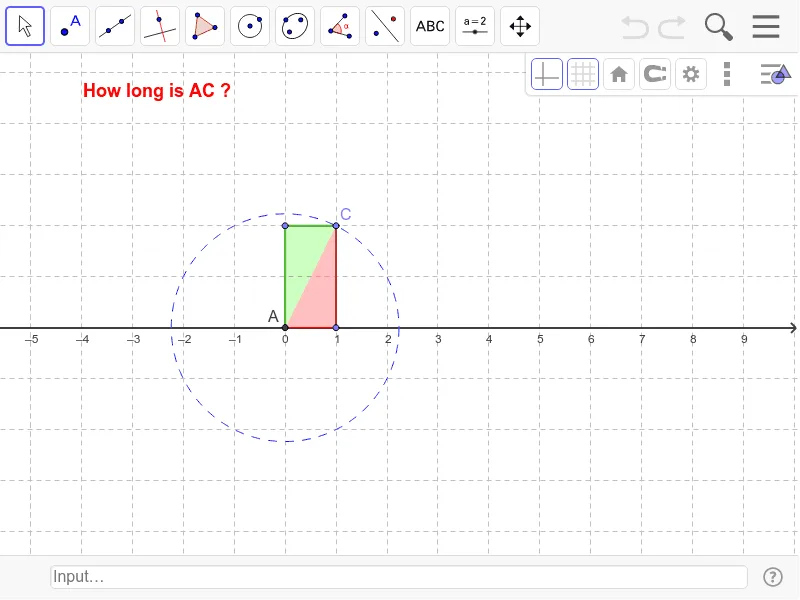
Measure the Diagonal of a Rectangle
Loading the math board and drawing, please wait…
In collections
Pythagoras
This example demonstrates the diagonal of a rectangle. Key mathematical concepts include geometric construction and segment construction. It uses commands such as Intersect, Point, OrthogonalLine, Line, Circle, Segment, Angle, Rotate, and Polygon in GeoGebra. Suitable for middle school and above students to learn geometric construction.
GeoGebra Commands & Parameters
Intersect(xAxis, yAxis) → APoint(xAxis) → B_1Point(yAxis) → C_1OrthogonalLine(B_1, xAxis) → aLine(C_1, xAxis) → bIntersect(a, b) → D_1Circle(A, D_1) → cSegment(A, C_1) → dSegment(C_1, D_1) → eSegment(D_1, B_1) → fPoint(c) → CAngle(D_1, A, C) → αRotate(C_1, α, A) → DRotate(B_1, α, A) → BPolygon(A, D, C) → poly1, e_1, a_1, f_1Polygon(A, B, C) → poly2, e_2, a_2, g
AI Drawing Prompt Reference
Draw a rectangle with two perpendicular sides AB and AC, and then draw the diagonal AD. Start by taking point B on the x-axis and point C on the y-axis. Draw a line perpendicular to the x-axis through B and a line parallel to the x-axis through C, and let their intersection be D. Draw a circle with center A and radius AD, and let it intersect the x-axis at C. Draw the angle bisector of ∠CAD and rotate points C and B around point A to form the angle bisector, resulting in the other two vertices of the rectangle, D and B.
The prompt above was compiled from the original drawing commands and is for reference only.