
Maximizing Volume of a Box: Dynamic Geometry and Optimization
Loading the math board and drawing, please wait…
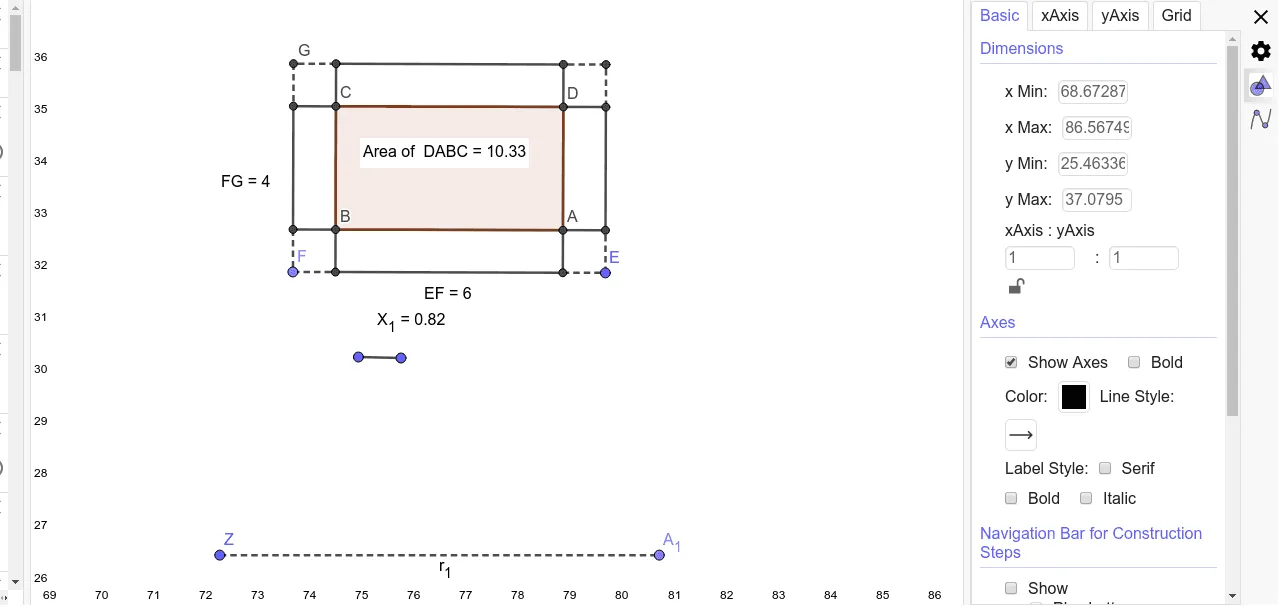
① This example demonstrates how to maximize the volume of a box by adjusting its dimensions interactively, showing the volume as a function of side lengths and its maximum point. ② Core mathematical concepts include volume formulas, function extrema, optimization, and the application of derivatives to find maxima, along with basic geometric elements like polygons, segments, and circles. ③ Construction highlights: uses GeoGebra commands such as Point, Segment, OrthogonalLine, Circle, Intersect, Distance, Polygon, PointIn, and Extremum to build the box and automatically compute the extremum, involving many objects like A_2, E, F, g, h, i, etc. ④ Suitable for high school or early college students, this is ideal for teaching optimization problems, derivative applications, and geometric visualization of maxima in a dynamic environment.
GeoGebra Commands & Parameters
Point(Circle[E, 6]) → FSegment(E, F) → gOrthogonalLine(F, g) → hOrthogonalLine(E, g) → iPoint(Circle[A_2, 4]) → B_2Segment(A_2, B_2) → fCircle(E, f) → cCircle(F, f) → dIntersect(c, i, 2) → E_1Intersect(d, h, 2) → GSegment(E_1, G) → jSegment(G, F) → kSegment(E, E_1) → mSegment(G_1, H) → X_1Circle(E_1, X_1) → eCircle(G, Segment[H, G_1]) → pCircle(E, X_1) → qCircle(F, X_1) → rIntersect(i, m) → IIntersect(i, m) → JIntersect(i, m) → KIntersect(i, m) → LIntersect(e, j) → M,Intersect(i, m) → NIntersect(e, m, 1) → OIntersect(q, m, 1) → PIntersect(r, k, 1) → SIntersect(p, k, 1) → TIntersect(r, g, 1) → QIntersect(q, g, 1) → RSegment(M, R) → lSegment(P, S) → sIntersect(p, j, 1) → USegment(Q, U) → tSegment(T, O) → aSegment(M, U) → bSegment(T, S) → f_1Segment(Q, R) → g_1Segment(P, O) → h_1Segment(U, G) → nSegment(G, T) → i_1Segment(S, F) → j_1Segment(F, Q) → k_1Segment(R, E) → l_1Segment(E, P) → m_1Segment(O, E_1) → n_1Segment(E_1, M) → p_1Distance(R, Q) → RQDistance(S, T) → STDistance(E, F) → distanceCDDistance(F, G) → distanceDFIntersect(l, a) → DIntersect(l, s) → AIntersect(s, t) → BIntersect(t, a) → CPolygon(D, A, B, C) → q1, z_1, a_1, b_1, c_1PointIn(q1) → Pointq1Extremum(q_1) → V, WPoint(Circle[Z, ((Distance[C, D] * Distance[D, A]) * X_1)]) → A_1Segment(Z, A_1) → r_1