
Max Bill Geometric Construction: Rotation and Polygon Nesting
Loading the math board and drawing, please wait…
In collections
Paintings modeled in Geogebra
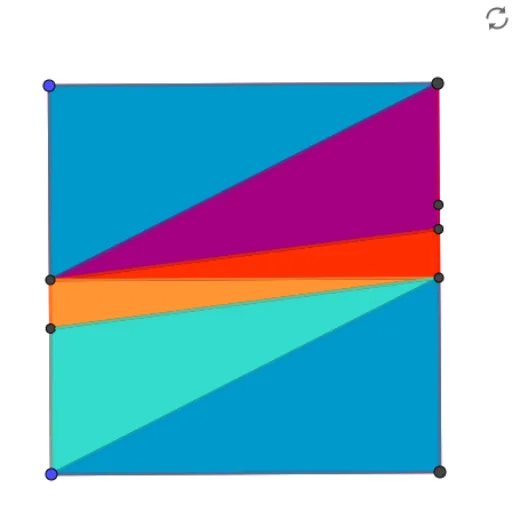
This example demonstrates a geometric construction inspired by the artist Max Bill, featuring nested polygons and rotational symmetry. It builds a rhythmic, symmetric pattern within a square framework using a series of triangles, quadrilaterals, and line segments. Core mathematical concepts include polygons, midpoints, rotation, relationships among integers and natural numbers, and properties of arbitrary triangles. Construction highlights: using GeoGebra commands such as Polygon to create base shapes, Midpoint to determine key centers, and Segment to connect points, while applying rotation (Rotație) to generate symmetric structures. Objects include A, B, poly1, multiple triangles (C, D, E, F), and auxiliary segments (f, g, h, i, etc.), resulting in a complex nested figure. Suitable for middle and high school geometry, art-mathematics integration, and explorations of geometric transformations and pattern design.
GeoGebra Commands & Parameters
Polygon(A, B, 4) → poly1, f, g, h, i, C, DMidpoint(A, B) → EMidpoint(D, C) → FSegment(E, F) → jSegment(F, B) → kSegment(E, D) → lMidpoint(D, F) → GMidpoint(G, F) → HMidpoint(H, G) → IMidpoint(E, B) → JMidpoint(E, J) → KMidpoint(K, J) → LMidpoint(E, J) → MMidpoint(J, M) → NSegment(H, E) → mSegment(M, F) → nPolygon(A, E, D) → t1, d, a, ePolygon(D, E, H, I) → q1, d_1, e_1, h_1, i_1Polygon(F, E, H) → t2, h_2, f_1, e_2Polygon(F, M, E) → t3, e_3, f_2, m_1Polygon(F, B, M) → t4, m_2, f_3, bPolygon(F, C, B) → t5, b_1, f_4, c