
Matrix Powers and Eigenvectors: Iterating a Linear Transformation
Loading the math board and drawing, please wait…
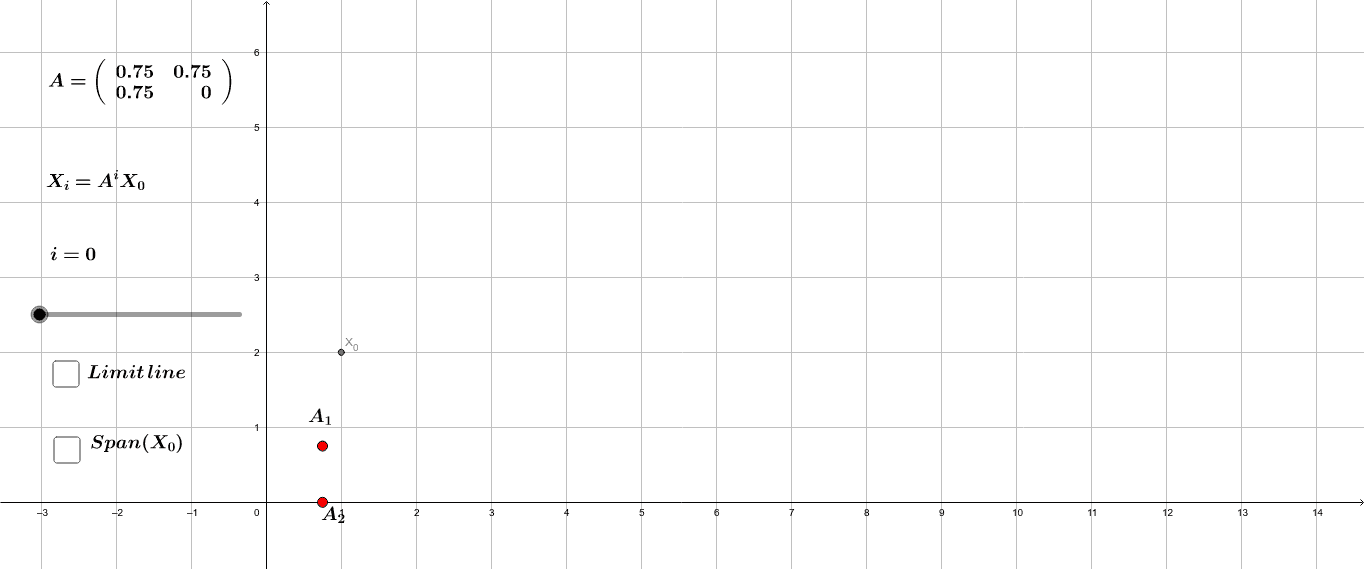
This GeoGebra example demonstrates how repeated multiplication by a matrix A transforms an initial vector X_0, producing a sequence of vectors whose directions reveal the influence of eigenvectors. It connects matrix powers, eigenvalues λ, eigenvectors, linear transformations, and iterative convergence. The construction uses Sequence to generate the vector sequence, Line and Intersect to define auxiliary directions or intersection points, and objects such as A, X_0, lmbda, n, S, and SL to represent the matrix, starting vector, eigenvalue, iteration count, and sequence or transformed results. Text objects provide labels and explanations. It is suitable for high school linear algebra extensions, introductory college linear algebra, or mathematical visualization activities.
GeoGebra Commands & Parameters
Intersect(xAxis, yAxis) → BLine(X_0, B) → aLine(F, B) → c_1Sequence("X_" + (i) + "=A*X_" + (i - 1), i, 1, n) → SSequence("ShowLabel(X_" + (i) + ",true)", i, 1, n) → SL
AI Drawing Prompt Reference
Draw a graph showing matrix power iterations. Start with vector X_0 from the origin, apply matrix A to generate sequence X_i. Include matrix A, starting vector X_0, sequence points X_1 to X_n, and lines connecting them. Arrows or line segments indicate transformation directions. Points along lines show direction changes and convergence trends. The graph should clearly display vector direction changes and convergence.
The prompt above was compiled from the original drawing commands and is for reference only.