
Lower Sum Approximation of Tetrahedron Volume (Cavalieri)
Loading the math board and drawing, please wait…
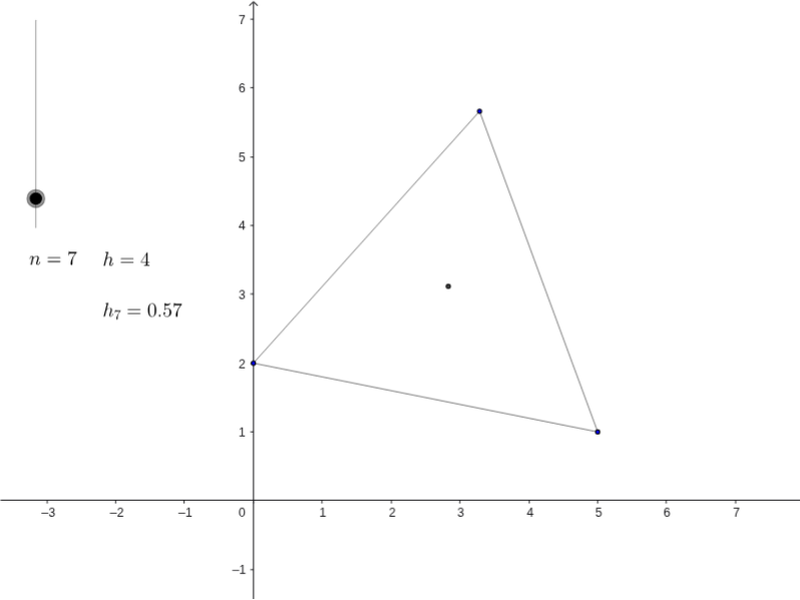
This GeoGebra example dynamically demonstrates how to approximate the volume of a tetrahedron using a lower sum of prisms, based on Cavalieri's principle. The core mathematical concepts include solid geometry (tetrahedron volume), Cavalieri's principle (equal cross-sectional areas imply equal volumes), and the Riemann lower sum idea from calculus. Construction details: the Sequence command generates a series of horizontal cross-sections, Segment and Length commands build the triangular bases, and a slider n controls the number of subdivisions. Key objects include tetrahedron vertices A, B, C, T, upper and lower cross-section points (A_up, B_up, C_up, A_down, B_down, C_down), prisms, and height h. This is suitable for high school or early college students to understand volume integration and approximation methods, and can serve as an introductory calculus demonstration.
GeoGebra Commands & Parameters
Sequence(A + (k / n * (T - A)), k, 1, n - 1) → A_{up}Sequence(B + (k / n * (T - B)), k, 1, n - 1) → B_{up}Sequence(C + (k / n * (T - C)), k, 1, n - 1) → C_{up}Sequence(Element[A_{up}, k] - (0, 0, h_{n}), k, 1, n - 1) → A_{down}Sequence(Element[B_{up}, k] - (0, 0, h_{n}), k, 1, n - 1) → B_{down}Sequence(Element[C_{up}, k] - (0, 0, h_{n}), k, 1, n - 1) → C_{down}Sequence(Prism[Element[A_{down}, k], Element[B_{down}, k], Element[C_{down}, k], Element[A_{up}, k]], k, 1, n - 1) → PrismsSegment(A, T) → aSegment(B, T) → bSegment(C, T) → cSegment(B, C) → dSegment(C, A) → eSegment(A, B) → fSegment(P, T) → heightLength(height) → h
AI Drawing Prompt Reference
Draw a tetrahedron with a slider to control the number of subdivisions, showing the process of approximating the volume using lower and upper cross-sections and prisms. Start by drawing the three lateral edges of the tetrahedron, then generate upper and lower cross-section points by dividing the height into equal parts based on the slider value, connect these points to form triangular bases, create prisms using these bases, and finally display how the prisms approximate the tetrahedron's volume.
The prompt above was compiled from the original drawing commands and is for reference only.