
Locus of Intersection of Orthogonal Tangents to an Ellipse
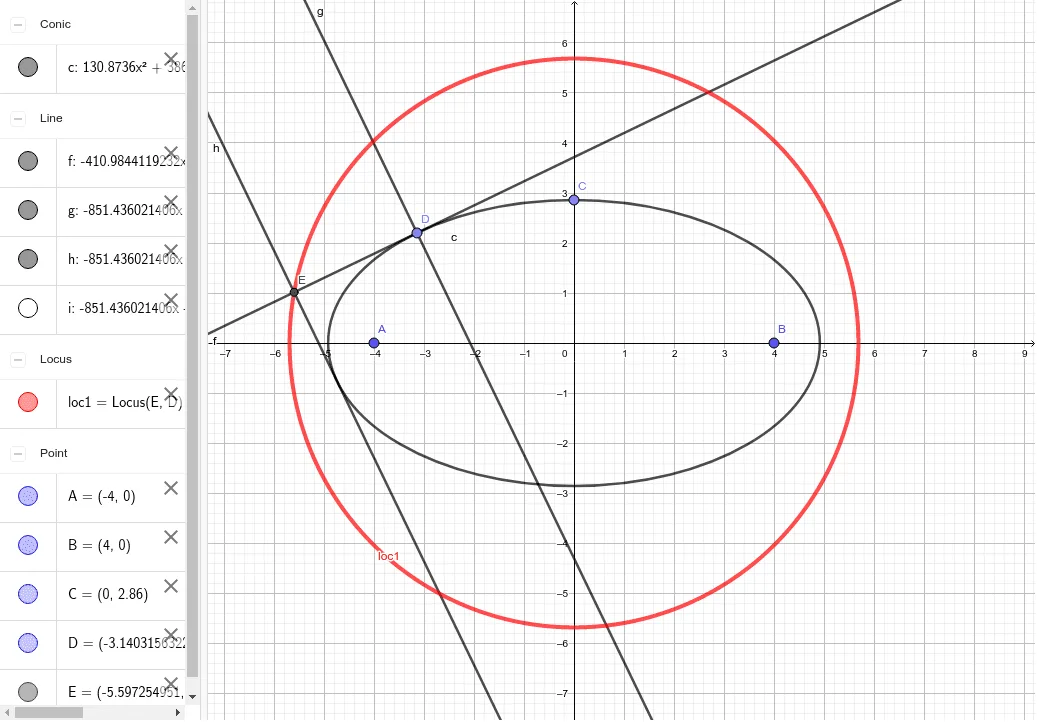
This applet demonstrates the locus of intersection points of two orthogonal tangents to an ellipse. In coordinate geometry, it is a classic result that all pairs of perpendicular tangent lines to an ellipse intersect on a fixed circle concentric with the ellipse. This circle is known as the director circle, or alternatively as the orthoptic circle or Monge circle. The applet provides an interactive, dynamic visualization of this theorem, making an abstract property immediately concrete and verifiable.
The construction begins with an ellipse drawn in the plane. A point is placed on the ellipse, and the tangent line at that point is drawn. A second tangent is constructed such that it is perpendicular to the first. The intersection point of these two orthogonal tangents is then computed and highlighted. As the user drags the tangent point along the ellipse, both tangents adjust in real time, and the intersection point traces out a path. The applet uses the trajectory command to visualize this path, revealing that it forms a perfect circle centered at the same point as the ellipse.
Students can interact with the applet by dragging the tangent point, adjusting the position and shape of the ellipse using built-in sliders, and toggling the visibility of auxiliary elements such as the director circle, the tangent lines, and the perpendicularity marker. These controls allow learners to test the property across a wide range of ellipses, including circles (where the director circle coincides with a concentric circle of radius sqrt(2) times the original) and highly eccentric ellipses, confirming that the result holds universally.
The mathematical concept illustrated here connects several key ideas in analytic and Euclidean geometry: the equation of a tangent to an ellipse, the condition for two lines to be perpendicular, and the definition of a locus. The director circle has radius sqrt(a^2 + b^2), where a and b are the semi-major and semi-minor axes of the ellipse. This applet allows students to verify this formula empirically by comparing the traced circle's radius against the calculated value.
By combining visual intuition with hands-on experimentation, the applet helps students move beyond memorizing a theorem to genuinely understanding why the director circle exists. It reinforces the power of dynamic geometry software in exploring and confirming classical results, making it a valuable tool for classroom instruction and independent study in analytic geometry.
Loading the math board and drawing, please wait…