
Lines of Symmetry in Quadrilaterals
Loading the math board and drawing, please wait…
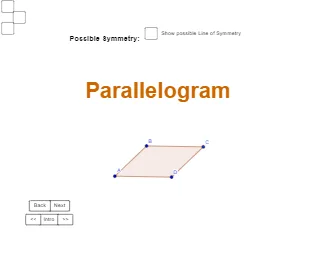
This example demonstrates how to find the lines of symmetry in a quadrilateral. It involves core mathematical concepts such as symmetry, line segments, angles, distances, and reflection transformations. The construction uses commands like Line, Segment, Angle, Distance, Point, Mirror, Intersect, Polygon, Circle, and OrthogonalLine in GeoGebra. Suitable for middle school students and above to explore geometric symmetry.
GeoGebra Commands & Parameters
Line(D, C) → fLine(B, C) → gSegment(B, C) → jSegment(C, D) → kLine(B, D) → mSegment(E, F) → pSegment(B, D) → tAngle(B, C, D) → γDistance(B, C) → distanceBCDistance(C, D) → distanceCDDistance(D, B) → distanceDBLine(J, K) → b_1Point(b_1) → LPoint(b_1) → NPoint(b_1) → OPoint(b_1) → QMirror(M, b_1) → M'Point(b_1) → PPoint(b_1) → RSegment(P, M) → c_1Segment(M, R) → f_1Segment(R, M') → g_1Segment(M', P) → h_1Segment(P, R) → i_1Segment(M, M') → j_1Intersect(i_1, j_1) → SLine(P, M') → k_1Line(M, R) → l_1Line(R, M') → m_1Line(M, P) → n_1Polygon(P, M, R, M') → poly3, p_1, m_2, r_1, m'Distance(P, M) → distancePMDistance(M, R) → distanceMRDistance(R, M') → distanceRM'Distance(M', P) → distanceM'PAngle(M', P, M) → ζAngle(P, M, R) → ηAngle(M, R, M') → θAngle(R, M', P) → ιAngle(P, S, M') → κDistance(M', M) → distanceM'MDistance(P, R) → distancePRSegment(T, U) → d_1Circle(S, Segment[U, T]) → e_1Point(e_1) → VLine(V, S) → q_1Mirror(P, q_1) → P'Mirror(M, q_1) → M'_1Mirror(R, q_1) → R'Mirror(M', q_1) → M''Polygon(P', M'_1, R', M'') → poly3', p', m'_1, r', m''Line(W, Z) → s_1Point(s_1) → B_1Point(s_1) → C_1Segment(B_1, C_1) → a_2Point(s_1) → D_1Point(s_1) → E_1Segment(D_1, E_1) → b_2Point(a_2) → H_1Line(A_1, F_1) → t_1Line(G_1, t_1) → c_2Point(c_2) → I_1Line(A_1, G_1) → h_2Line(F_1, I_1) → i_2Line(A_1, F_1) → j_2Line(I_1, G_1) → k_2Distance(G_1, A_1) → distanceG1A1Distance(A_1, F_1) → distanceA1F1Distance(F_1, I_1) → distanceF1I1Distance(I_1, G_1) → distanceI1G1Angle(I_1, G_1, A_1) → λAngle(G_1, A_1, F_1) → μAngle(A_1, F_1, I_1) → νAngle(F_1, I_1, G_1) → ξSegment(A_1, I_1) → l_2Segment(G_1, F_1) → n_2Intersect(l_2, n_2) → K_1Distance(G_1, F_1) → distanceG1F1Distance(A_1, I_1) → distanceA1I1Angle(G_1, K_1, I_1) → οPolygon(G_1, A_1, F_1, I_1) → poly4, g_2, a_3, f_2, i_3Segment(J_1, L_1) → d_2Circle(K_1, Segment[J_1, L_1]) → e_2Point(e_2) → M_1Line(K_1, M_1) → p_2Mirror(G_1, p_2) → N_1Mirror(A_1, p_2) → O_1Mirror(F_1, p_2) → P_1Mirror(I_1, p_2) → Q_1Polygon(N_1, O_1, P_1, Q_1) → poly4', n_3, o_1, p_3, q_2Line(R_1, S_1) → r_2Line(T_1, r_2) → s_2Segment(R_1, T_1) → t_2Circle(S_1, Segment[R_1, S_1]) → c_3Circle(S_1, Segment[R_1, T_1]) → d_3Circle(R_1, Segment[T_1, S_1]) → e_3Intersect(d_3, e_3, 2) → U_1Segment(T_1, U_1) → b_3Segment(U_1, S_1) → f_3Segment(S_1, R_1) → g_3Intersect(t_2, f_3) → V_1Intersect(b_3, g_3) → W_1Distance(U_1, V_1) → distanceU1V1Distance(U_1, W_1) → distanceU1W1Intersect(f_2, g_2) → Z_1Polygon(R_1, T_1, U_1, S_1) → poly5, r_3, t_3, u_1, s_3Line(R_1, T_1) → h_3Line(S_1, U_1) → j_3Line(T_1, U_1) → k_3Line(R_1, S_1) → l_3Segment(T_1, S_1) → m_3Segment(R_1, U_1) → q_3Intersect(m_3, q_3) → A_2Segment(B_2, C_2) → a_4Circle(A_2, Segment[B_2, C_2]) → c_4Point(c_4) → D_2Line(A_2, D_2) → b_4Mirror(R_1, b_4) → E_2Mirror(T_1, b_4) → F_2Mirror(U_1, b_4) → G_2Mirror(S_1, b_4) → H_2Polygon(E_2, F_2, G_2, H_2) → poly5', e_4, f_4, g_4, h_4Distance(R_1, T_1) → distanceR1T1Distance(T_1, U_1) → distanceT1U1Distance(U_1, S_1) → distanceU1S1Distance(S_1, R_1) → distanceS1R1Distance(R_1, U_1) → distanceR1U1Distance(T_1, S_1) → distanceT1S1Angle(R_1, A_2, S_1) → ρAngle(S_1, R_1, T_1) → σAngle(R_1, T_1, U_1) → τAngle(T_1, U_1, S_1) → υAngle(U_1, S_1, R_1) → ϕLine(I_2, J_2) → d_4Line(K_2, d_4) → i_4Line(K_2, I_2) → j_4Line(J_2, j_4) → k_4Intersect(i_4, k_4) → L_2Polygon(K_2, I_2, J_2, L_2) → poly6, k_5, i_5, j_5, l_4Line(I_2, K_2) → m_4Line(J_2, L_2) → n_4Line(I_2, J_2) → p_4Line(K_2, L_2) → q_4Segment(K_2, J_2) → r_4Segment(I_2, L_2) → s_4Intersect(r_4, s_4) → M_2Segment(N_2, O_2) → t_4Circle(M_2, Segment[N_2, O_2]) → c_5Point(c_5) → P_2Line(M_2, P_2) → a_5Mirror(K_2, a_5) → Q_2Mirror(I_2, a_5) → R_2Mirror(J_2, a_5) → S_2Mirror(L_2, a_5) → T_2Polygon(Q_2, R_2, S_2, T_2) → poly6', q_5, r_5, s_5, t_5Distance(I_2, K_2) → distanceI2K2Distance(K_2, L_2) → distanceK2L2Distance(L_2, J_2) → distanceL2J2Distance(J_2, I_2) → distanceJ2I2Distance(I_2, L_2) → distanceI2L2Distance(K_2, J_2) → distanceK2J2Angle(J_2, I_2, K_2) → χAngle(I_2, K_2, L_2) → ψAngle(K_2, L_2, J_2) → ωAngle(L_2, J_2, I_2) → α_1Angle(I_2, M_2, J_2) → β_1Distance(I_2, J_2) → distanceI2J2Distance(I_2, L_2) → v_1Distance(K_2, J_2) → w_1Circle(U_2, V_2) → d_5Point(d_5) → W_2Segment(V_2, W_2) → b_5Mirror(U_2, b_5) → Z_2Polygon(W_2, U_2, V_2, Z_2) → poly7, w_2, u_2, v_2, z_2Segment(U_2, Z_2) → e_5Intersect(b_5, e_5) → A_3Distance(W_2, V_2) → distanceW2V2Distance(U_2, Z_2) → distanceU2Z2Angle(W_2, A_3, Z_2) → γ_1Angle(Z_2, W_2, U_2) → δ_1Angle(W_2, U_2, V_2) → ε_1Angle(U_2, V_2, Z_2) → ζ_1Angle(V_2, Z_2, W_2) → η_1Distance(W_2, U_2) → distanceW2U2Distance(U_2, V_2) → distanceU2V2Distance(V_2, Z_2) → distanceV2Z2Distance(Z_2, W_2) → distanceZ2W2Segment(B_3, C_3) → f_5Circle(A_3, Segment[B_3, C_3]) → g_5Point(g_5) → D_3Line(D_3, A_3) → h_5Mirror(W_2, h_5) → E_3Mirror(U_2, h_5) → F_3Mirror(V_2, h_5) → G_3Mirror(Z_2, h_5) → H_3Polygon(E_3, F_3, G_3, H_3) → poly7', e_6, f_6, g_6, h_6Line(W_2, U_2) → l_5Line(U_2, V_2) → m_5Line(V_2, Z_2) → n_5Line(Z_2, W_2) → p_5Segment(I_3, J_3) → a_6OrthogonalLine(I_3, a_6) → b_6OrthogonalLine(J_3, a_6) → c_6Point(b_6) → K_3Line(K_3, b_6) → d_6Line(K_3, d_6) → i_6Line(K_3, a_6) → j_6Intersect(c_6, j_6) → L_3Polygon(I_3, K_3, L_3, J_3) → poly8, i_7, k_6, l_6, j_7Distance(I_3, K_3) → distanceI3K3Distance(K_3, L_3) → distanceK3L3Distance(L_3, J_3) → distanceL3J3Distance(J_3, I_3) → distanceJ3I3Angle(J_3, I_3, K_3) → θ_1Angle(I_3, K_3, L_3) → ι_1Angle(K_3, L_3, J_3) → κ_1Angle(L_3, J_3, I_3) → λ_1Segment(K_3, J_3) → m_6Segment(I_3, L_3) → n_6Intersect(m_6, n_6) → M_3Line(I_3, K_3) → p_6Line(K_3, L_3) → q_6Line(L_3, J_3) → r_6Line(J_3, I_3) → s_6Angle(I_3, M_3, J_3) → μ_1Distance(I_3, L_3) → distanceI3L3Distance(K_3, J_3) → distanceK3J3Segment(N_3, O_3) → t_6Circle(M_3, Segment[N_3, O_3]) → c_7Point(c_7) → P_3Line(M_3, P_3) → a_7Mirror(I_3, a_7) → Q_3Mirror(K_3, a_7) → R_3Mirror(L_3, a_7) → S_3Mirror(J_3, a_7) → T_3Polygon(Q_3, R_3, S_3, T_3) → poly8', q_7, r_7, s_7, t_7Segment(A, G) → aOrthogonalLine(A, a) → bOrthogonalLine(G, a) → cCircle(A, Segment[A, G]) → dCircle(G, Segment[A, G]) → eIntersect(d, b, 2) → HIntersect(e, c, 2) → IPolygon(A, H, I, G) → poly1, a_1, h, i, g_7Segment(H, G) → lSegment(I, A) → nIntersect(l, n) → U_3Line(H, I) → qLine(G, A) → rLine(A, H) → b_7Line(I, G) → d_7Angle(G, U_3, I) → αAngle(G, A, H) → βAngle(A, H, I) → δAngle(H, I, G) → εAngle(I, G, A) → ν_1Distance(A, H) → distanceAHDistance(H, I) → distanceHIDistance(I, G) → distanceIGDistance(G, A) → distanceGADistance(A, I) → distanceAIDistance(H, G) → distanceHGSegment(B, V_3) → e_7Segment(V_3, D) → f_7Polygon(V_3, B, C, D) → poly2, v_3, b_8, c_8, d_8Line(B, V_3) → h_7Line(V_3, D) → k_7Segment(C, V_3) → l_7Intersect(t, l_7) → W_3Intersect(c_8, v_3) → Z_3Intersect(d_8, b_8) → A_4Segment(B_4, C_4) → m_7Circle(W_3, Segment[B_4, C_4]) → p_7Point(p_7) → D_4Line(W_3, D_4) → n_7Mirror(V_3, n_7) → E_4Mirror(B, n_7) → B'Mirror(C, n_7) → C'Mirror(D, n_7) → D'Polygon(E_4, B', C', D') → poly2', e_8, b', c', d'Mirror(B', b') → B''Mirror(C', b') → C''Distance(V_3, B) → distanceV3BDistance(B, C) → z_1Distance(C, D) → o_2Distance(D, V_3) → distanceDV3Distance(V_3, C) → distanceV3CDistance(B, D) → distanceBDAngle(D, V_3, B) → ξ_1Angle(V_3, B, C) → ο_1Angle(B, C, D) → ρ_1Angle(C, D, V_3) → σ_1Angle(V_3, W_3, D) → τ_1Segment(F_4, G_4) → a_8Circle(U_3, Segment[F_4, G_4]) → f_8Point(f_8) → H_4Line(U_3, H_4) → g_8Mirror(A, g_8) → A'Mirror(H, g_8) → H'Mirror(I, g_8) → I'Mirror(G, g_8) → G'Polygon(A', H', I', G') → poly1', a', h', i', g'
AI Drawing Prompt Reference
Draw a quadrilateral and find its lines of symmetry. Start by constructing the four sides and two diagonals of the quadrilateral, then measure the lengths of the sides and the angles. Next, locate the midpoint of one diagonal and draw a perpendicular line through it, which is a line of symmetry for the quadrilateral. Finally, use reflection to verify the symmetry across the line.
The prompt above was compiled from the original drawing commands and is for reference only.