
Linear Programming and Polygon Construction
Loading the math board and drawing, please wait…
In collections
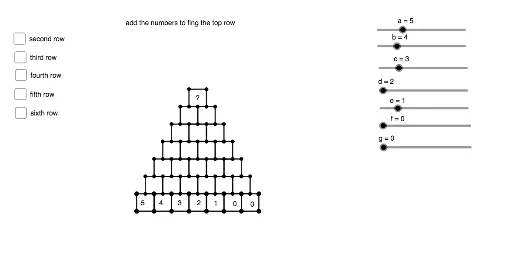
Pyramid Puzzles
This example dynamically demonstrates linear programming problems, visually showing how the optimal solution is determined within a polygonal region. It involves core mathematical concepts such as linear inequalities, feasible regions, optimal solutions, polygon construction, and coordinate geometry. GeoGebra commands like Polygon and Midpoint, along with objects A, B, C, D, are used to construct the graphics and locus. Suitable for high school and above learners to understand the integration of linear programming and analytical geometry.
GeoGebra Commands & Parameters
Polygon(A, B, 4) → poly1, f_6, g_6, h, i, C, DPolygon(D, C, 4) → poly2, j, k, l, m, E, FPolygon(F, E, 4) → poly3, n, p, q, r, G, HPolygon(H, G, 4) → poly4, s, t, a_6, b_6, I, JPolygon(J, I, 4) → poly5, c_6, d_5, e_5, f_1, K, LMidpoint(A, D) → MMidpoint(D, F) → NMidpoint(F, H) → OMidpoint(H, J) → PMidpoint(J, L) → QPolygon(M, N, 4) → poly6, g_1, h_1, i_1, j_1, R, SPolygon(R, N, 4) → poly7, k_1, l_1, m_1, n_1, T, UPolygon(U, O, 4) → poly8, p_1, q_1, r_1, s_1, V, WPolygon(W, P, 4) → poly9, t_1, a_1, b_1, c_1, Z, A_1Midpoint(S, R) → B_1Midpoint(R, U) → C_1Midpoint(U, W) → D_1Midpoint(W, A_1) → E_1Polygon(B_1, C_1, 4) → poly10, d_1, e_1, f_2, g_2, F_1, G_1Polygon(F_1, C_1, 4) → poly11, h_2, i_2, j_2, k_2, H_1, I_1Polygon(I_1, D_1, 4) → poly12, l_2, m_2, n_2, p_2, J_1, K_1Midpoint(G_1, F_1) → L_1Midpoint(F_1, I_1) → M_1Midpoint(I_1, K_1) → N_1Polygon(L_1, M_1, 4) → poly13, q_2, r_2, s_2, t_2, O_1, P_1Polygon(O_1, M_1, 4) → poly14, a_2, b_2, c_2, d_2, Q_1, R_1Midpoint(P_1, O_1) → S_1Midpoint(O_1, R_1) → T_1Polygon(S_1, T_1, 4) → poly15, e_2, f_3, g_3, h_3, U_1, V_1Polygon(L, K, 4) → poly16, i_3, j_3, k_3, l_3, W_1, Z_1Polygon(Z_1, W_1, 4) → poly17, m_3, n_3, p_3, q_3, A_2, B_2Midpoint(L, Z_1) → C_2Midpoint(Z_1, B_2) → D_2Polygon(A_1, Q, 4) → poly18, r_3, s_3, t_3, a_3, E_2, F_2Polygon(F_2, C_2, 4) → poly19, b_3, c_3, d_3, e_3, G_2, H_2Midpoint(A_1, F_2) → I_2Midpoint(F_2, H_2) → J_2Polygon(K_1, E_1, 4) → poly20, f_4, g_4, h_4, i_4, K_2, L_2Polygon(L_2, I_2, 4) → poly21, j_4, k_4, l_4, m_4, M_2, N_2Midpoint(K_1, L_2) → O_2Midpoint(L_2, N_2) → P_2Polygon(R_1, N_1, 4) → poly22, n_4, p_4, q_4, r_4, Q_2, R_2Polygon(R_2, O_2, 4) → poly23, s_4, t_4, a_4, b_4, S_2, T_2Midpoint(R_1, R_2) → U_2Midpoint(R_2, T_2) → V_2Polygon(U_1, T_1, 4) → poly24, c_4, d_4, e_4, f_5, W_2, Z_2Polygon(Z_2, U_2, 4) → poly25, g_5, h_5, i_5, j_5, A_3, B_3Midpoint(V_1, U_1) → C_3Midpoint(U_1, Z_2) → D_3Polygon(C_3, D_3, 4) → poly26, k_5, l_5, m_5, n_5, E_3, F_3Polygon(E_3, D_3, 4) → poly27, p_5, q_5, r_5, s_5, G_3, H_3Midpoint(F_3, E_3) → I_3Midpoint(E_3, H_3) → J_3Polygon(I_3, J_3, 4) → poly28, t_5, a_5, b_5, c_5, K_3, L_3