
Linear Interpolation
Loading the math board and drawing, please wait…
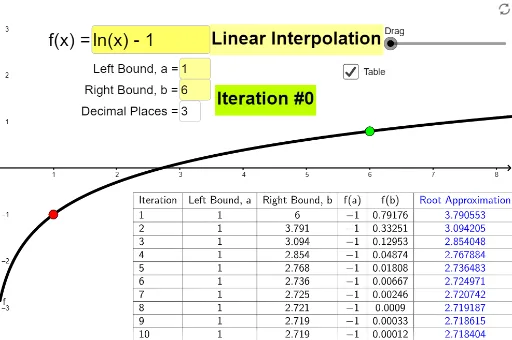
This example demonstrates the process of linear interpolation, a method of estimating values between known data points. Using commands from the construction summary, such as If, Sequence, and Textfield, we can see how these GeoGebra objects are utilized. Suitable for high school mathematics education and learning.
GeoGebra Commands & Parameters
If(sgn(f(C2)) ≟ sgn(f(A2)), C2, A2) → A3If(sgn(f(C2)) ≟ sgn(f(B2)), C2, B2) → B3If(sgn(f(C3)) ≟ sgn(f(A3)), C3, A3) → A4If(sgn(f(C3)) ≟ sgn(f(B3)), C3, B3) → B4If(sgn(f(C4)) ≟ sgn(f(A4)), C4, A4) → A5If(sgn(f(C4)) ≟ sgn(f(B4)), C4, B4) → B5If(sgn(f(C5)) ≟ sgn(f(A5)), C5, A5) → A6If(sgn(f(C5)) ≟ sgn(f(B5)), C5, B5) → B6If(sgn(f(C6)) ≟ sgn(f(A6)), C6, A6) → A7If(sgn(f(C6)) ≟ sgn(f(B6)), C6, B6) → B7If(sgn(f(C7)) ≟ sgn(f(A7)), C7, A7) → A8If(sgn(f(C7)) ≟ sgn(f(B7)), C7, B7) → B8If(sgn(f(C8)) ≟ sgn(f(A8)), C8, A8) → A9If(sgn(f(C8)) ≟ sgn(f(B8)), C8, B8) → B9If(sgn(f(C9)) ≟ sgn(f(A9)), C9, A9) → A10If(sgn(f(C9)) ≟ sgn(f(B9)), C9, B9) → B10If(sgn(f(C10)) ≟ sgn(f(A10)), C10, A10) → A11If(sgn(f(C10)) ≟ sgn(f(B10)), C10, B10) → B11If(sgn(f(C11)) ≟ sgn(f(A11)), C11, A11) → A12If(sgn(f(C11)) ≟ sgn(f(B11)), C11, B11) → B12If(sgn(f(C12)) ≟ sgn(f(A12)), C12, A12) → A13If(sgn(f(C12)) ≟ sgn(f(B12)), C12, B12) → B13If(sgn(f(C13)) ≟ sgn(f(A13)), C13, A13) → A14If(sgn(f(C13)) ≟ sgn(f(B13)), C13, B13) → B14If(sgn(f(C14)) ≟ sgn(f(A14)), C14, A14) → A15If(sgn(f(C14)) ≟ sgn(f(B14)), C14, B14) → B15If(sgn(f(C15)) ≟ sgn(f(A15)), C15, A15) → A16If(sgn(f(C15)) ≟ sgn(f(B15)), C15, B15) → B16Sequence((Element[lA, i], f(Element[lA, i])), i, 1, Drag + 0.75) → ListASequence((Element[lB, i], f(Element[lB, i])), i, 1, Drag + 0.5) → ListBSequence((Element[lC, i], 0), i, 1, Drag + 0.25) → ListCSequence(Segment[Element[ListC, i], (x(Element[ListC, i]), f(x(Element[ListC, i])))], i, 1, Drag) → ListVerticalSequence(Segment[Element[ListA, i], Element[ListB, i]], i, 1, Drag + 0.5) → ListLineTableText({{D1, E1, F1, G1, H1, I1, J1}, {D2, E2, F2, G2, H2, I2, J2}, {D3, E3, F3, G3, H3, I3, J3}, {D4, E4, F4, G4, H4, I4, J4}, {D5, E5, F5, G5, H5, I5, J5}, {D6, E6, F6, G6, H6, I6, J6}, {D7, E7, F7, G7, H7, I7, J7}, {D8, E8, F8, G8, H8, I8, J8}, {D9, E9, F9, G9, H9, I9, J9}, {D10, E10, F10, G10, H10, I10, J10}, {D11, E11, F11, G11, H11, I11, J11}, {D12, E12, F12, G12, H12, I12, J12}, {D13, E13, F13, G13, H13, I13, J13}, {D14, E14, F14, G14, H14, I14, J14}, {D15, E15, F15, G15, H15, I15, J15}, {D16, E16, F16, G16, H16, I16, J16}}, "|_lcccccc") → text1Textfield(f) → InputBox1Textfield(a) → InputBox2Textfield(b) → InputBox3Textfield(dp) → InputBox4