
Limit Definition Demonstration
Loading the math board and drawing, please wait…
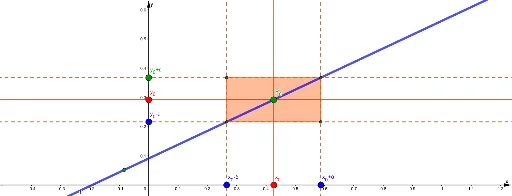
This example dynamically demonstrates the concept of a limit, using the behavior of a function near a point as an example. Key math concepts include limit, slope, and mirror reflection. Construction highlights involve GeoGebra commands/objects like Point, Line, Slope, Mirror, LaTeX, Intersect, Polygon. Suitable for high school calculus students to understand the geometric meaning and calculation of limits.
GeoGebra Commands & Parameters
Point(yAxis) → PyrLine(A, B) → fSlope(f) → mMirror(Pyr, Py) → PylLine(Pyr, xAxis) → gLine(Pyl, xAxis) → hMirror(Pxr, Px) → PxlLine(Pxr, yAxis) → iLine(Pxl, yAxis) → jLaTeX(e, true, true) → text1Line(Py, xAxis) → kLine(Px, yAxis) → lIntersect(g, j) → CIntersect(f, g) → DIntersect(h, i) → EIntersect(f, h) → FPolygon(C, D, E, F) → q1, c, d_1, e_1, f_1
AI Drawing Prompt Reference
Draw a function graph and a dynamic limit demonstration near a point. Start by drawing the y-axis, then take a point Pyr on the y-axis and draw a line f through Pyr and another point B. Calculate the slope m of f, then mirror Pyr to get Pyl. Draw the line g through Pyr and the x-axis, and the line h through Pyl and the x-axis. Mirror Pyl to get Pxl, then draw the line i through Pxr and the y-axis, and the line j through Pxl and the y-axis. Find the intersection C of g and j, D of f and g, E of h and i, and F of f and h. Finally, draw a quadrilateral q1 with points C, D, E, and F.
The prompt above was compiled from the original drawing commands and is for reference only.