
Length Ratios in Similar Triangles by Dan
Loading the math board and drawing, please wait…
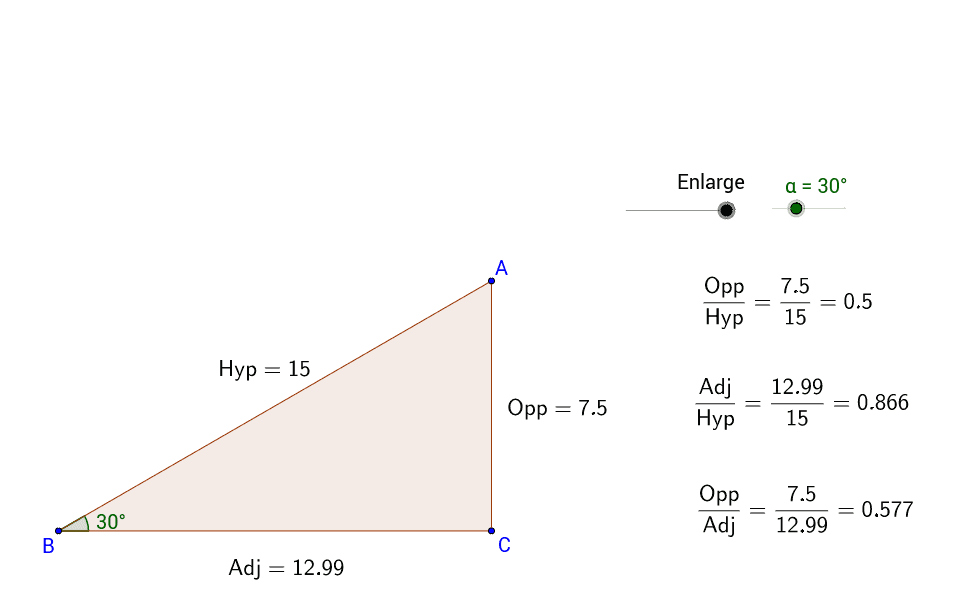
This example demonstrates the constancy of corresponding side length ratios in similar triangles. It involves core math concepts like triangle similarity criteria and properties, ratio relationships, and trigonometry. Construction highlights the use of GeoGebra commands/objects such as Rotate, Angle, Polygon, Dilate, Distance, and Midpoint. Suitable for high school mathematics instruction to visually understand similarity and ratio calculations.
GeoGebra Commands & Parameters
Rotate(A_1, α, B) → A'Angle(A_1, B, A') → βPolygon(B, C_1, A') → poly1, a', b_1, cDilate(B, Enlarge, B) → B'Dilate(C_1, Enlarge, B) → CDilate(A', Enlarge, B) → APolygon(B', C, A) → poly1', a'', b', c'Distance(A, C) → distanceACMidpoint(A, C) →Distance(B, C) → distanceBCMidpoint(B, C) →Midpoint(b') → DMidpoint(a'') → EMidpoint(c') → FDistance(A, B) → distanceABMidpoint(A, B) →
AI Drawing Prompt Reference
Draw two similar triangles by rotating the vertex of the first triangle and scaling it to create the second triangle, demonstrating equal ratios of corresponding side lengths. Use a slider to adjust the rotation angle and scaling factor, and mark the midpoints of each side, calculating and displaying the distances between corresponding midpoints to verify the constant ratio of side lengths in similar triangles.
The prompt above was compiled from the original drawing commands and is for reference only.