
Lateral Surface Area of a Cuboid Self Assessment
Loading the math board and drawing, please wait…
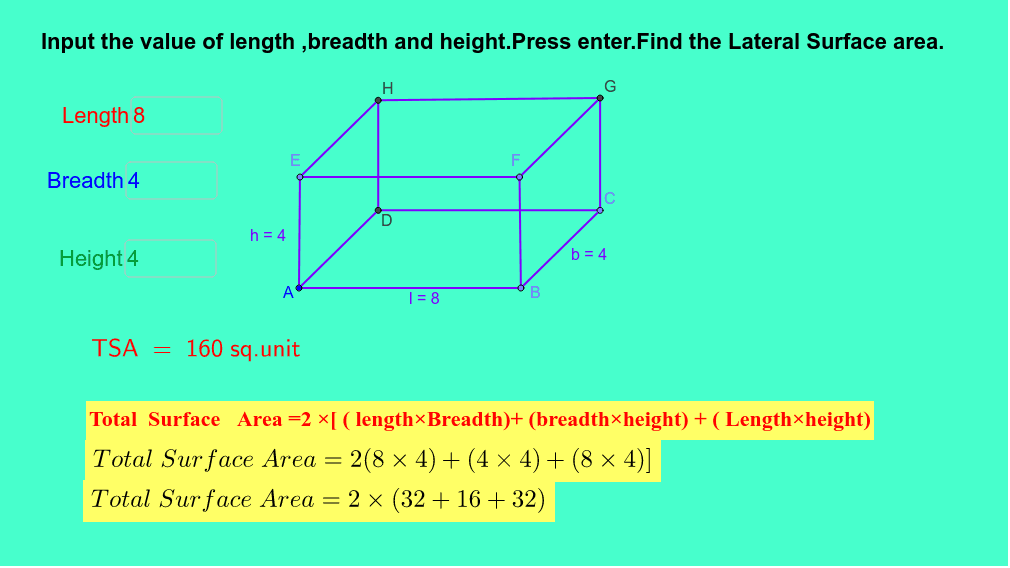
This example demonstrates the concept of the lateral surface area of a cuboid. It involves the geometric construction of a cuboid and uses GeoGebra commands such as TextField, Point, Segment, Line, etc., to help students understand how to calculate the lateral surface area. Suitable for self-assessment and learning for middle school and above students.
GeoGebra Commands & Parameters
Textfield(l_1) → inputBox1Textfield(b_2) → inputBox2Textfield(h_1) → inputBox3Textfield(l_1) → inputBox1_1Textfield(b_2) → inputBox2_1Textfield(h_1) → inputBox3_1Textfield(l_1) → inputBox1_2Textfield(b_2) → inputBox2_2Textfield(h_1) → inputBox3_2Textfield(l_1) → inputBox1_3Textfield(b_2) → inputBox2_3Textfield(h_1) → inputBox3_3Point(Circle[A, abs(l_1)]) → BSegment(A, B) → lPoint(Circle[B, abs(b_2)]) → CSegment(B, C) → bLine(C, l) → dLine(A, b) → eIntersect(e, d) → DSegment(D, C) → fSegment(D, A) → gOrthogonalLine(A, l) → iOrthogonalLine(B, l) → jOrthogonalLine(D, f) → kOrthogonalLine(C, f) → mPoint(Circle[A, abs(h_1)]) → ESegment(A, E) → hPoint(Circle[B, abs(h_1)]) → FSegment(B, F) → pLine(E, g) → qLine(E, l) → rLine(F, b) → sIntersect(m, s) → GIntersect(q, k) → HSegment(H, G) → tSegment(F, G) → a_1Segment(E, H) → b_1Segment(C, G) → c_1Segment(H, D) → d_1Segment(E, F) → e_1Textfield(l_1) → inputBox1_4Textfield(b_2) → inputBox2_4Textfield(h_1) → inputBox3_4Textfield(l_1) → inputBox1_5Textfield(b_2) → inputBox2_5Textfield(h_1) → inputBox3_5Textfield(l_1) → inputBox1_6Textfield(b_2) → inputBox2_6Textfield(h_1) → inputBox3_6Textfield(l_1) → inputBox1_7Textfield(b_2) → inputBox2_7Textfield(h_1) → inputBox3_7Point(Circle[A_1, abs(l_1)]) → B_1Segment(A_1, B_1) → l_2Point(Circle[B_1, abs(b_2)]) → C_1Segment(B_1, C_1) → b_3Line(C_1, l_2) → d_2Line(A_1, b_3) → e_2OrthogonalLine(A_1, l_2) → i_1OrthogonalLine(B_1, l_2) → j_1Point(Circle[A_1, abs(h_1)]) → E_1Segment(A_1, E_1) → h_2Line(E_1, l_2) → r_1Textfield(l_1) → inputBox1_8Textfield(b_2) → inputBox2_8Textfield(h_1) → inputBox3_8Textfield(l_1) → inputBox1_9Textfield(b_2) → inputBox2_9Textfield(h_1) → inputBox3_9Textfield(l_1) → inputBox1_{10}Textfield(b_2) → inputBox2_{10}Textfield(h_1) → inputBox3_{10}Textfield(l_1) → inputBox1_{11}Textfield(b_2) → inputBox2_{11}Textfield(h_1) → inputBox3_{11}Point(Circle[A_2, abs(l_1)]) → B_2Segment(A_2, B_2) → l_3Point(Circle[B_2, abs(b_2)]) → C_2Segment(B_2, C_2) → b_4Line(C_2, l_3) → d_3Line(A_2, b_4) → e_3OrthogonalLine(A_2, l_3) → i_2OrthogonalLine(B_2, l_3) → j_2Point(Circle[A_2, abs(h_1)]) → E_2Segment(A_2, E_2) → h_3Line(E_2, l_3) → r_2Textfield(l_1) → inputBox1_{12}Textfield(b_2) → inputBox2_{12}Textfield(h_1) → inputBox3_{12}Textfield(l_1) → inputBox1_{13}Textfield(b_2) → inputBox2_{13}Textfield(h_1) → inputBox3_{13}Textfield(l_1) → inputBox1_{14}Textfield(b_2) → inputBox2_{14}Textfield(h_1) → inputBox3_{14}Textfield(l_1) → inputBox1_{15}Textfield(b_2) → inputBox2_{15}Textfield(h_1) → inputBox3_{15}Textfield(l_1) → inputBox1_{16}Textfield(b_2) → inputBox2_{16}Textfield(h_1) → inputBox3_{16}Textfield(l_1) → inputBox1_{17}Textfield(b_2) → inputBox2_{17}Textfield(h_1) → inputBox3_{17}Textfield(l_1) → inputBox1_{18}Textfield(b_2) → inputBox2_{18}Textfield(h_1) → inputBox3_{18}Textfield(l_1) → inputBox1_{19}Textfield(b_2) → inputBox2_{19}Textfield(h_1) → inputBox3_{19}Point(Circle[A_3, abs(l_1)]) → B_3Segment(A_3, B_3) → l_4Point(Circle[B_3, abs(b_2)]) → C_3Segment(B_3, C_3) → b_5Line(C_3, l_4) → d_4Line(A_3, b_5) → e_4OrthogonalLine(A_3, l_4) → i_3OrthogonalLine(B_3, l_4) → j_3Point(Circle[A_3, abs(h_1)]) → E_3Segment(A_3, E_3) → h_4Line(E_3, l_4) → r_3Textfield(l_1) → inputBox1_{20}Textfield(b_2) → inputBox2_{20}Textfield(h_1) → inputBox3_{20}Textfield(l_1) → inputBox1_{21}Textfield(b_2) → inputBox2_{21}Textfield(h_1) → inputBox3_{21}Textfield(l_1) → inputBox1_{22}Textfield(b_2) → inputBox2_{22}Textfield(h_1) → inputBox3_{22}Textfield(l_1) → inputBox1_{23}Textfield(b_2) → inputBox2_{23}Textfield(h_1) → inputBox3_{23}Textfield(l_1) → inputBox1_{24}Textfield(b_2) → inputBox2_{24}Textfield(h_1) → inputBox3_{24}Textfield(l_1) → inputBox1_{25}Textfield(b_2) → inputBox2_{25}Textfield(h_1) → inputBox3_{25}Textfield(l_1) → inputBox1_{26}Textfield(b_2) → inputBox2_{26}Textfield(h_1) → inputBox3_{26}Textfield(l_1) → inputBox1_{27}Textfield(b_2) → inputBox2_{27}Textfield(h_1) → inputBox3_{27}Textfield(l_1) → inputBox1_{28}Textfield(b_2) → inputBox2_{28}Textfield(h_1) → inputBox3_{28}Textfield(l_1) → inputBox1_{29}Textfield(b_2) → inputBox2_{29}Textfield(h_1) → inputBox3_{29}Textfield(l_1) → inputBox1_{30}Textfield(b_2) → inputBox2_{30}Textfield(h_1) → inputBox3_{30}Textfield(l_1) → inputBox1_{31}Textfield(b_2) → inputBox2_{31}Textfield(h_1) → inputBox3_{31}
AI Drawing Prompt Reference
Draw a cuboid and label its length, width, and height. First, input the length, width, and height values, then construct the cuboid's edges and faces based on these values. Start by drawing the length, then the width, connect the length and width to form the base, draw the height, and finally connect the vertices to form the lateral faces of the cuboid.
The prompt above was compiled from the original drawing commands and is for reference only.