
Kite Proof: Geometric Construction and Angle Relations
Loading the math board and drawing, please wait…
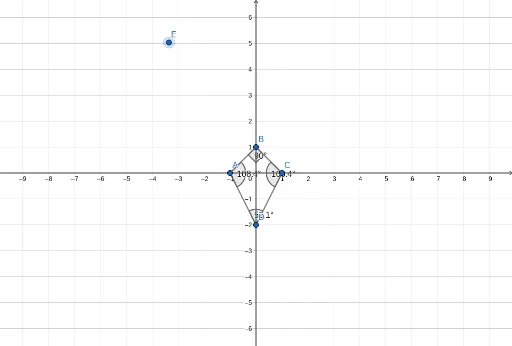
This GeoGebra example demonstrates the construction and proof of properties of a kite quadrilateral. A kite is a special quadrilateral with two pairs of adjacent equal sides, typically possessing one axis of symmetry. The core mathematical concepts include isosceles triangles, symmetry, angle bisectors, and the sum of interior angles of a quadrilateral. Construction details: using GeoGebra commands Point, Segment, Line, and Angle, the vertices A, B, C, D and auxiliary lines f, g, h, i, j, k are created, with angles α, β, γ, δ labeled. Through measurement and reasoning, the angle relations (such as the symmetry axis bisecting opposite angles) are verified. This is suitable for middle school or high school geometry classes, serving as an interactive tool to explore the definition, properties, and proof of kites, and as an introductory dynamic geometry activity.
GeoGebra Commands & Parameters
Point(xAxis) → APoint(yAxis) → BSegment(A, B) → fPoint(xAxis) → CSegment(B, C) → gPoint(yAxis) → DSegment(C, D) → hSegment(D, A) → iLine(A, C) → jLine(D, B) → kAngle(D, A, B) → αAngle(B, C, D) → βAngle(C, B, A) → γAngle(C, D, A) → δ
AI Drawing Prompt Reference
Draw a kite-shaped quadrilateral with vertices placed on the positive and negative axes, creating a symmetric figure. Start by drawing two adjacent sides, then complete the other two sides to form a closed shape. Add two diagonals: one horizontal and one slanted. Finally, label four interior angles at the vertices: upper-left, lower-right, upper-right, and lower-left. The figure should clearly show two pairs of adjacent equal sides and a symmetry axis that bisects opposite angles.
The prompt above was compiled from the original drawing commands and is for reference only.