
Kite Construction with Integral Visualization
Loading the math board and drawing, please wait…
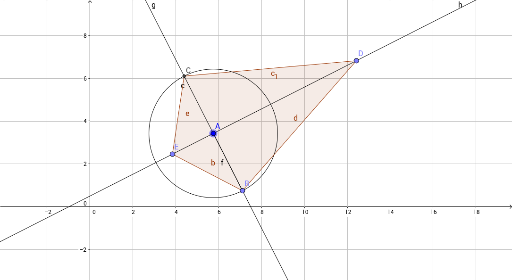
This GeoGebra example demonstrates a dynamic kite-shaped polygon combined with secant lines, median lines, vectors, and Riemann sums (upper and lower sums), illustrating the connection between geometry and calculus. The core mathematical concepts include the symmetry properties of a kite, relationships between secant and median lines, indefinite integrals and numerical approximation via Riemann sums, and the use of vectors in geometric construction. The construction uses GeoGebra commands such as Point, Segment, Circle, Line, Intersect, OrthogonalLine, and Polygon, creating points A and B, circles f and c, line g, intersection C, perpendicular line h, points D and E, polygon poly1, and auxiliary circle c_1, lines d, b, and e, resulting in a kite figure with an integral visualization region. Suitable for high school to early college students, this example helps learners understand how geometric constructions can be integrated with calculus concepts, and serves as a teaching tool for dynamic geometry and Riemann sum approximations.
GeoGebra Commands & Parameters
Point(Circle[A, 3]) → BSegment(A, B) → fCircle(A, f) → cLine(A, f) → gIntersect(c, g, 1) → COrthogonalLine(A, f) → hPoint(h) → DPoint(h) → EPolygon(C, D, B, E) → poly1, c_1, d, b, e