
Kite Construction: Symmetric Quadrilateral via Perpendicular Bisectors and Midpo
Loading the math board and drawing, please wait…
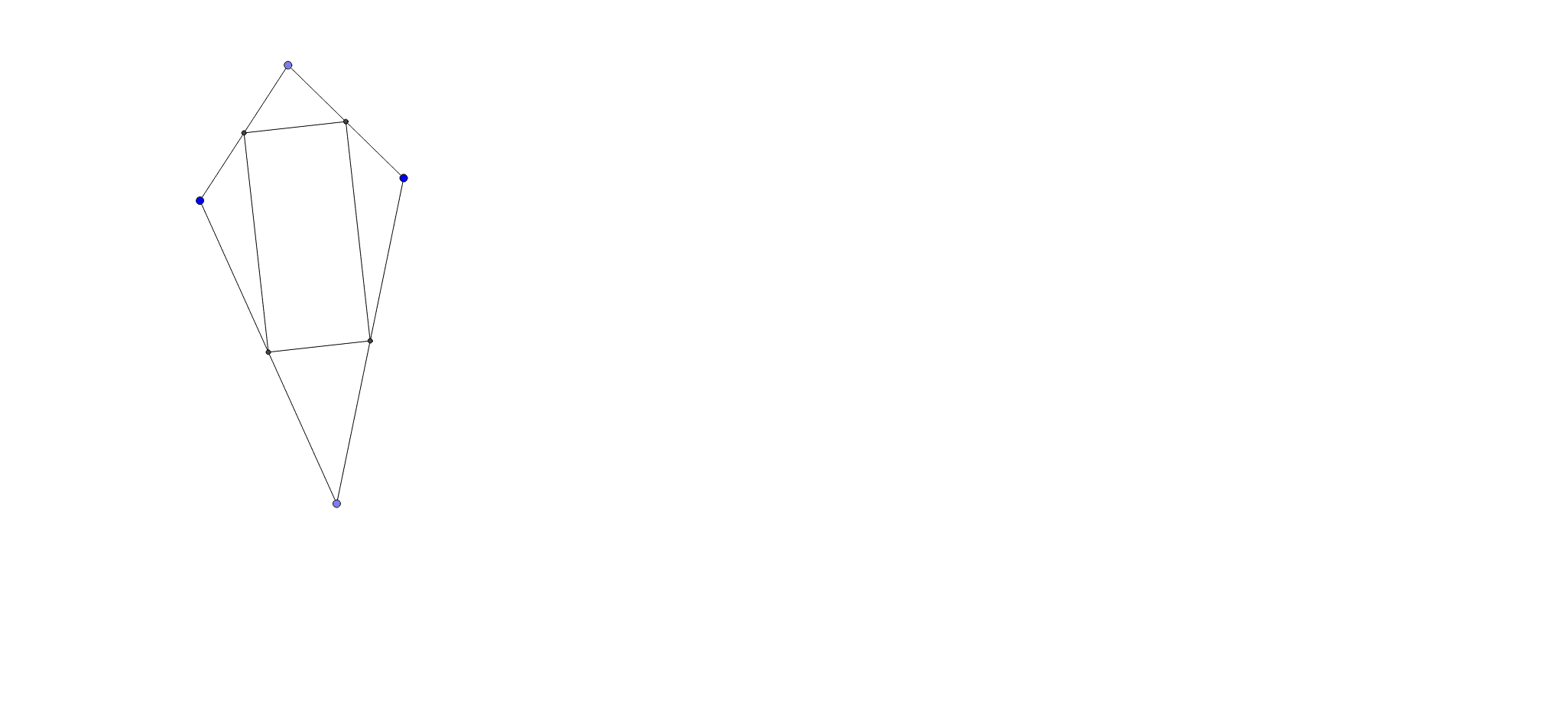
① This example demonstrates how to construct a kite-shaped quadrilateral, a symmetric figure with two pairs of adjacent equal sides, using geometric construction tools. ② Core mathematical concepts include axial symmetry, perpendicular bisectors, midpoints, and properties of quadrilaterals; a kite has perpendicular diagonals with one bisecting the other. ③ Construction highlights: from the summary, the GeoGebra commands used are LineBisector (to create the symmetry axis), Point and Segment (to define vertices and edges), and Midpoint (to mark midpoints); objects include points A, B, C, D and segments a, b, c, d, leading to key points E, F, G, H forming the kite. ④ Suitable for middle school geometry or introductory high school analytic geometry, useful for visualizing symmetry, perpendicular bisector properties, and quadrilateral classification, and as a starting point for dynamic geometry exploration.
GeoGebra Commands & Parameters
LineBisector(A, B) → aPoint(a) → CPoint(a) → DSegment(A, D) → bSegment(B, D) → cSegment(A, C) → dSegment(C, B) → eMidpoint(A, C) → EMidpoint(C, B) → FMidpoint(D, A) → GMidpoint(B, D) → HSegment(E, F) → fSegment(E, G) → gSegment(F, H) → hSegment(G, H) → i