
Kite Construction: Angle Bisectors and Circumcircle
Loading the math board and drawing, please wait…
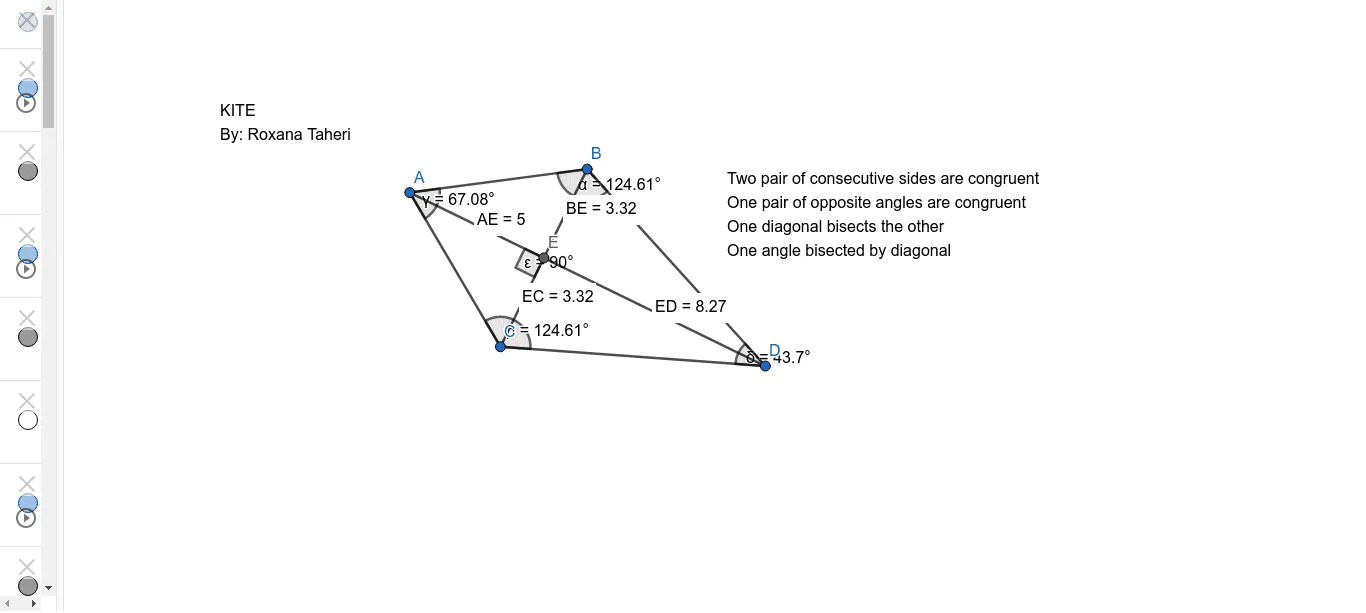
This GeoGebra example demonstrates how to construct a kite (a quadrilateral with two pairs of adjacent equal sides) using angle bisectors, intersections, and distance measurements, and explores its geometric properties such as side lengths, angles, and the circumcircle. Core mathematical concepts include the definition of a kite, properties of angle bisectors, triangle congruence, cyclic quadrilaterals (circumcircle), and the application of standard deviation in a geometric context. The construction uses GeoGebra commands: Point, Segment, AngularBisector, Intersect, Angle, Distance, and Midpoint, creating points A, B, C, D, E, segments f, g, h, i, j, k, l, angle bisectors, and measuring distances (AE, BE, EC, ED) and angles (α, β, γ, δ, ε) with text labels. This example is suitable for middle and high school geometry classes, helping students understand kite construction, angle bisector applications, and the integration of statistics with geometry.
GeoGebra Commands & Parameters
Point(Circle[A, 6]) → BSegment(A, B) → fPoint(Circle[A, 6]) → CSegment(A, C) → gAngularBisector(C, A, B) → hPoint(h) → DSegment(D, B) → iSegment(C, D) → jSegment(A, D) → kSegment(B, C) → lIntersect(k, l) → EAngle(A, B, D) → αAngle(D, C, A) → βAngle(C, A, B) → γAngle(B, D, C) → δAngle(A, E, C) → εDistance(A, E) → distanceAEMidpoint(A, E) →Distance(B, E) → distanceBEMidpoint(B, E) →Distance(E, C) → distanceECMidpoint(E, C) →Distance(E, D) → distanceEDMidpoint(E, D) →