
Kaleidogons: Rotational Symmetry Art with Polygons
Loading the math board and drawing, please wait…
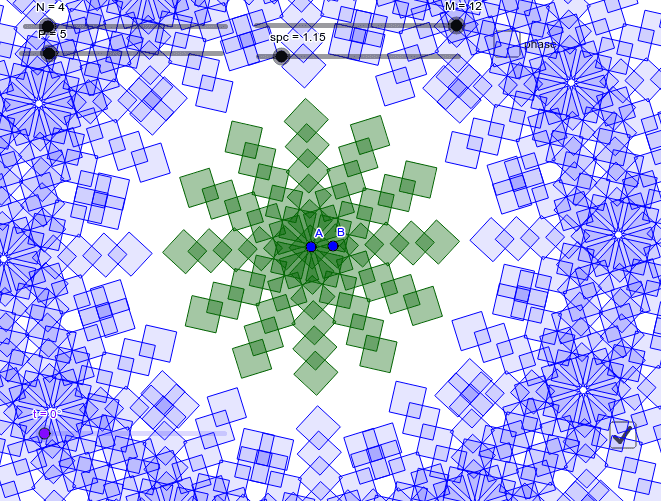
① This example demonstrates a kaleidoscopic pattern formed by multiple regular polygons rotated around a common center, creating dynamic symmetric visuals controlled by sliders. ② Core mathematical concepts include rotational symmetry, sequence generation, parametric control, and random variables (for color or position), involving polygons, angles, and transformations. ③ Construction highlights: using GeoGebra's Rotate command to rotate polygons and Sequence to generate a series of rotated copies; key objects include spc (control parameter), P, M, A, B, N (points/vertices), t (slider), poly1 (base polygon), list1 and list2 (lists storing rotated results), m (count), a (angle); sliders adjust rotation angle and number in real time. ④ Suitable for middle school and above, this example is ideal for exploring geometric transformations, symmetry, and the intersection of mathematics and art, as well as for dynamic geometry or introductory programming activities.
GeoGebra Commands & Parameters
Rotate(Polygon[B, Rotate[B, (360 * ° / N), A], N], t, A) → poly1Sequence(Rotate[Sequence[Translate[poly1, Vector[((k * spc) * Vector[A, B])]], k, 1, P], ((i * 360 / M))°, A], i, 1, M) → list1Sequence(Translate[list1, Vector[((M + 2) * Vector[A, Rotate[B, (((i * 360))° + ((m * 180))°) / M, A]])]], i, 1, M) → list2