
Justin Lanier's Star Fractal
Loading the math board and drawing, please wait…
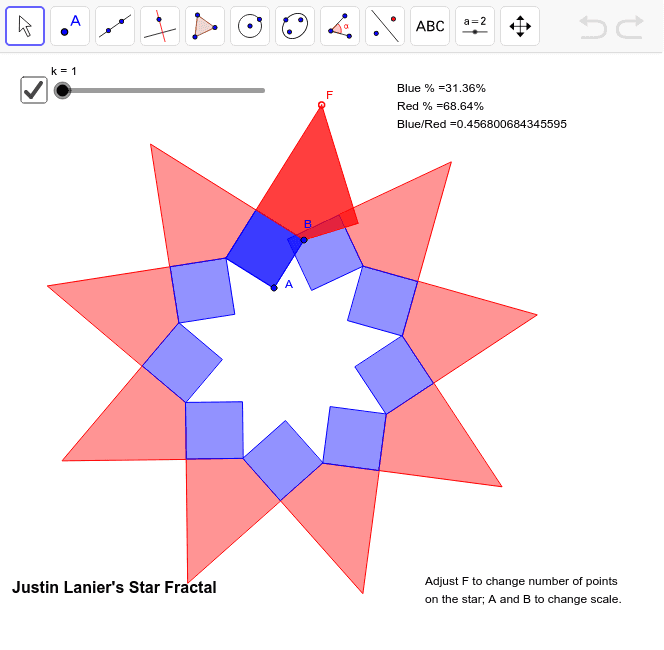
This example demonstrates the construction of a star fractal through geometric transformations and iteration. Key mathematical concepts include angles, dilation, rotation, vectors, and transformations. The construction involves GeoGebra commands such as Polygon, Ray, Rotate, Intersect, etc. It is suitable for high school students or college undergraduates to learn about geometric transformations and fractal geometry.
GeoGebra Commands & Parameters
Polygon(A, B, 4) → poly1, a, b, c, d, C, DRay(C, E) → ePoint(e) → FLine(F, B) → fMirror(C, f) → C'Polygon(F, C', B, C) → poly2, f_1, c', b_1, c_1Line(B, C) → gLine(A, B) → hAngle(f, g) → αRotate(C, α, C) → C'_1Rotate(E, α, C) → E'Rotate(C, α, D) → C'_2Rotate(E, α, D) → E'_1Ray(C'_2, E'_1) → e'Intersect(f, e') → GAngle(B, G, C'_2) → βSequence(Polygon[Rotate[F, (i * β), G], Rotate[C', (i * β), G], Rotate[B, (i * β), G], Rotate[C, (i * β), G]], i, 1, n - 1) → list1Sequence(Rotate[poly1, (i * β), G], i, 1, n - 1) → list2Append(list1, poly2) → list1'Append(list2, poly1) → list2'Sequence(Dilate[list1', ratio^(i), G], i, 1, k - 1) → list3Sequence(Dilate[list2', ratio^(i), G], i, 1, k - 1) → list4
AI Drawing Prompt Reference
Draw a star fractal by first constructing a quadrilateral with points A and B, then drawing a ray from point C and finding its intersection with line segment FB to get point F. Mirror point C with respect to F to get C', and construct a new quadrilateral with vertices F, C', B, and C. Then, draw line segments BC and AB, calculate angle α, and rotate points C and E around points C and D to get C'1 and E'1. Draw a ray from C'2 to E'1 and find its intersection with line segment FB to get point G, calculate angle β, and rotate points F, C', B, C, and the quadrilateral around point G to generate a series of new quadrilaterals, finally dilate these quadrilaterals proportionally.
The prompt above was compiled from the original drawing commands and is for reference only.