
Jumping and Triangular Surfaces: A Stochastic Process-Driven Dynamic Geometry De
Loading the math board and drawing, please wait…
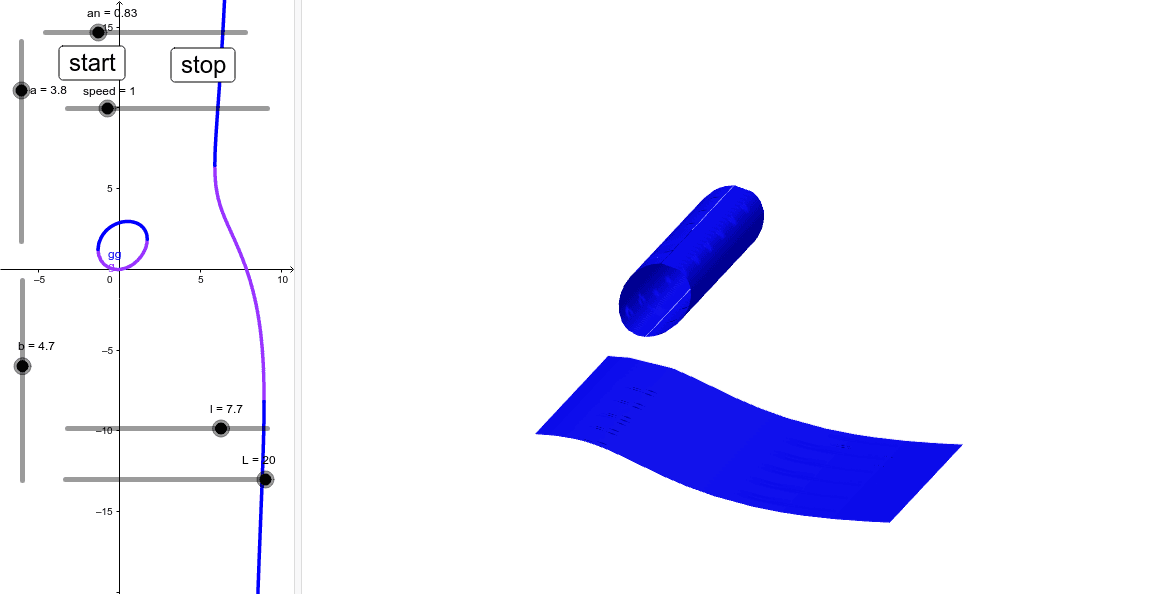
This GeoGebra example demonstrates a dynamic surface whose shape is driven by a stochastic process, integrated with triangles, trigonometric functions, and special points. The core mathematical concepts include parametric surfaces, random walks/stochastic processes, trigonometric periodicity, and loci of special triangle points (e.g., centroid, incenter). The construction uses the Surface command to define the surface, with sliders (Bouton1, Bouton2) and a speed parameter controlling the evolution of the random process, thereby dynamically altering the surface geometry. Objects such as a, b, an, g, gg, l, L, s, ss likely represent side lengths, angles, point sets, or auxiliary curves. This example is suitable for high school to undergraduate students, offering an intuitive visualization of how stochastic processes can be combined with geometric surfaces, and serves as an extension for mathematical modeling or computer-assisted geometry instruction.
GeoGebra Commands & Parameters
Surface(v, g(u), (-u), u, (-L), L, v, (-l), l) → sSurface(v, gg(u), (-u), u, (-L), L, v, (-l), l) → ss
AI Drawing Prompt Reference
Create a dynamic triangular surface driven by a stochastic process. The surface is formed by sweeping two parametric curves vertically, each based on trigonometric functions with random fluctuations, creating a wavy triangular mesh. Two auxiliary curves flank the surface, giving a symmetric wave-like appearance. Include two sliders to control the speed of the random evolution, altering the surface's undulation. Mark several special points, such as centroid and incenter of triangles, which move with the surface, tracing paths. The overall visual combines mathematical precision with dynamic aesthetics, illustrating the blend of randomness and geometric structure.
The prompt above was compiled from the original drawing commands and is for reference only.