
Isosceles Triangle Demonstration
Loading the math board and drawing, please wait…
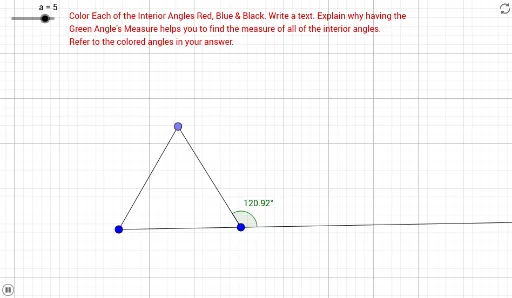
This example demonstrates the properties and construction of isosceles triangles. It involves core concepts like the definition of isosceles triangles, congruent base angles, and the perpendicularity of the angle bisector to the base. The construction uses commands and objects such as Polygon, Point, Segment, Line, Angle, Midpoint, Ray, OrthogonalLine, Mirror, and Circle in GeoGebra. It is suitable for middle school and above students learning geometric constructions and properties exploration.
GeoGebra Commands & Parameters
Polygon(C, A, B) → poly1, b, c, a_1Point(Circle[D, 8]) → ESegment(D, E) → fPoint(Circle[D, 8]) → FSegment(D, F) → gPoint(Circle[F, 8]) → GSegment(F, G) → hLine(D, E) → iPolygon(D, F, G) → poly2, g_1, d, f_1Polygon(D, F, E) → poly3, e, d_1, f_2Segment(D, E) → jAngle(D, E, F) → αAngle(E, F, D) → βAngle(E, G, F) → γAngle(F, D, E) → δMidpoint(H, I) → JRay(H, J) → kOrthogonalLine(J, k) → lPoint(l) → KSegment(K, H) → mSegment(K, I) → nPoint(k) → LAngle(L, I, K) → εMirror(M, N) → M'Segment(M, M') → pOrthogonalLine(N, p) → qPoint(q) → OSegment(M, O) → rSegment(M', O) → sSegment(M', M) → tRay(M, O) → h_1Point(h_1) → PAngle(P, O, M') → ζCircle(Q, R) → c_1Point(c_1) → SPoint(c_1) → TSegment(S, Q) → i_1Segment(T, Q) → k_1Segment(T, S) → j_1Angle(T, Q, S) → ηAngle(S, T, Q) → θAngle(Q, S, T) → ιPoint(c) → USegment(U, C) → l_1Polygon(V, W, Z) → t1, z_1, v, wAngle(V, W, Z) → κAngle(Z, V, W) → λAngle(W, Z, V) → μAngle(D, F, E) → νAngle(E, D, F) → ξAngle(F, E, D) → οAngle(E, F, G) → ρAngle(G, E, F) → σAngle(F, G, E) → τ